🔓 Open Access Policy | Global Journal of Engineering and Technology Advances (GJETA)
Promoting Free, Immediate and Worldwide Access to Scholarly Research
The Global Journal of Engineering and Technology Advances (GJETA) follows an open access publishing model that makes published research freely available online to readers worldwide. Open access removes subscription barriers and allows researchers, educators, students, professionals, institutions, policymakers, and the public to read and discover scholarly content without paying access fees.
This Open Access Policy explains how GJETA provides public access to published articles, supports lawful sharing and reuse, applies copyright and licensing conditions, promotes research visibility, and preserves the integrity of the scholarly record. It also clarifies the responsibilities of authors and readers when accessing, sharing, citing, or reusing published content.
🎯 Purpose of the Open Access Policy
The purpose of this Open Access Policy is to ensure that research published by GJETA can be accessed broadly and efficiently while protecting author attribution, copyright, licensing conditions, publication integrity, and ethical scholarly use.
The policy helps GJETA:
- remove subscription barriers to published research;
- increase the visibility and discoverability of scholarly articles;
- support international knowledge sharing;
- promote educational, scientific, professional, and public use of research;
- encourage lawful sharing and citation;
- clarify author and reader responsibilities;
- support long-term access to published content.
📘 Meaning of Open Access
Open access means that published scholarly content is made available online without subscription charges or institutional access restrictions. Readers may access the full text of published articles through the journal website and other authorised scholarly platforms.
Open access does not mean that copyright, licensing, attribution, ethical standards, or restrictions on third-party material no longer apply. Users must follow the licence and rights information displayed with each article.
🌍 Immediate Worldwide Availability
Articles published by the Global Journal of Engineering and Technology Advances (GJETA) are intended to become accessible online following completion of editorial review, acceptance, production, and publication.
Open access allows readers worldwide to:
- read published articles;
- download permitted article files;
- share lawful links to the official publication;
- cite published research;
- use articles for education and scholarly discussion;
- discover engineering and technology research without institutional subscription barriers.
🔬 Open Access and Research Visibility
Removing access barriers can improve the reach of published research by allowing a wider international audience to discover, read, discuss, cite, and build upon scholarly findings.
Open access may benefit:
- authors seeking wider research visibility;
- researchers without access to subscription databases;
- students and educators;
- industry professionals and engineers;
- institutions in developing regions;
- policymakers and public organisations;
- interdisciplinary research communities.
📚 Open Access and Scholarly Communication
Open access supports the rapid exchange of scientific and technical knowledge across institutions, countries, disciplines, and professional communities. It can help reduce duplication of research effort, support collaboration, and accelerate innovation.
For engineering and technology research, broad access may assist with:
- development of new methods and technologies;
- comparison of technical results;
- reuse of published knowledge in education and professional training;
- interdisciplinary collaboration;
- application of research findings to practical problems;
- dissemination of emerging research from underrepresented regions.
👨🔬 Author Responsibilities Under Open Access
Authors submitting manuscripts to GJETA should ensure that they have the right to publish the submitted work under the journal’s open access conditions.
Authors are responsible for:
- submitting original work;
- obtaining permission for third-party copyrighted material;
- providing accurate author and affiliation information;
- complying with funding and institutional open access requirements;
- reviewing the applicable copyright and licensing terms;
- ensuring that publication does not violate contractual or intellectual property obligations.
📄 Author Permission to Publish
Authors whose manuscripts are accepted may be required to grant the journal the permissions necessary to publish, display, distribute, archive, index, preserve, and make the article publicly available.
These permissions support:
- online publication;
- open access distribution;
- metadata sharing with scholarly services;
- repository and preservation activities;
- linking of corrections, retractions, and updates;
- long-term maintenance of the publication record.
🔗 Crossref DOI and Persistent Access
Published articles may receive a Crossref Digital Object Identifier (DOI) to support persistent identification, citation, linking, discoverability, and long-term access.
A DOI provides a stable reference that helps readers locate an article even when website structures or URLs change. Authors and readers are encouraged to use the DOI in citations, repository records, academic profiles, and scholarly communication.
📌 Open Access Principle
The Global Journal of Engineering and Technology Advances (GJETA) supports free online access to published research while requiring proper attribution, respect for copyright and licensing conditions, and responsible scholarly use.
📜 Open Access Licensing
Articles published by GJETA may be distributed under a stated open access licence. The licence identifies how readers may access, copy, share, distribute, translate, adapt, or reuse the article.
Users should review the licence information displayed with the article before reusing content. Reuse beyond the licence conditions may require permission from the author, journal, publisher, or another rights holder.
🏷️ Attribution Requirements
Open access reuse must preserve accurate attribution to the original authors and publication.
Appropriate attribution should normally include:
- the author names;
- the article title;
- the journal name;
- the year, volume, issue, and pages where applicable;
- the article DOI or official link;
- the applicable licence;
- an indication when content has been modified.
🔁 Sharing Published Articles
Readers and authors may share published articles according to the applicable licence and journal policies.
Lawful sharing may include:
- sharing the official article link;
- distributing the article for permitted educational or scholarly use;
- depositing eligible versions in repositories;
- including the article in academic reading lists;
- citing or quoting permitted portions;
- sharing through institutional or professional networks where allowed.
✂️ Adaptations and Translations
Where permitted by the applicable licence, users may prepare translations, summaries, adaptations, or derivative works. Modified content should clearly identify the original source and explain that changes were made.
Adaptations must not:
- misrepresent the original findings;
- remove author attribution;
- conceal corrections or retractions;
- create false endorsement by the authors or GJETA;
- alter conclusions in a deceptive or misleading manner.
🖼️ Third-Party Material in Open Access Articles
Not all material appearing in an open access article is necessarily covered by the article’s licence. Figures, tables, photographs, maps, software screenshots, datasets, questionnaires, and other third-party materials may be subject to separate rights or permission conditions.
Users should review credit lines and copyright notices before reusing third-party content.
📚 Author Self-Archiving
Authors may be permitted to archive eligible versions of their manuscripts in institutional repositories, subject repositories, personal websites, or academic networks according to the journal’s self-archiving conditions.
Authors should consult the Author Self-Archiving Policy before depositing:
- the submitted manuscript;
- the accepted manuscript;
- the final published article;
- supplementary material.
🔖 Repository Linking and Version Identification
Archived manuscript records should identify the version being deposited and should link to the final published article where possible.
Repository records should include:
- the final citation;
- the article DOI;
- the journal name;
- the publication date;
- the applicable licence or repository conditions;
- information about corrections or retractions where relevant.
🏢 Institutional and Funder Open Access Requirements
Some institutions, research funders, governments, or grant agreements require authors to publish open access or deposit manuscripts in repositories.
Authors are responsible for confirming that publication in GJETA is compatible with:
- funder open access mandates;
- institutional repository policies;
- licence requirements;
- embargo conditions;
- intellectual property obligations;
- research grant agreements.
💰 Article Processing Charges and Open Access
Open access publishing may involve an Article Processing Charge (APC) to support editorial administration, peer review coordination, production, hosting, DOI services, archiving, website maintenance, and public access.
GJETA offers a low Article Processing Charge of USD 35 / INR 2100. Payment of publication charges does not guarantee acceptance and does not influence editorial screening, reviewer selection, peer review, revision requirements, or final publication decisions.
⚖️ Editorial Independence
Open access fees remain separate from academic and editorial decisions. Manuscripts are evaluated according to:
- originality;
- technical quality;
- methodological reliability;
- ethical compliance;
- relevance to the journal’s scope;
- the quality of the scholarly contribution.
Editors and reviewers should not be influenced by an author’s ability to pay publication charges.
📜 Waivers, Discounts and Payment Arrangements
Where applicable, authors may contact the journal regarding payment arrangements, discounts, or special circumstances. Any financial communication should remain separate from peer review and editorial decision-making.
A fee-related request does not affect the academic evaluation of the manuscript.
🚫 Open Access Does Not Mean Automatic Acceptance
Open access describes how published articles are made available to readers. It does not mean that submitted manuscripts are automatically accepted or published without independent editorial assessment and peer review.
Every accepted article must satisfy the journal’s academic, technical, ethical, and editorial standards.
🌐 Access Through the Journal Website
The official GJETA website serves as the primary source for published articles, article metadata, corrections, retractions, policy information, and related journal records.
Readers are encouraged to use the official article page or DOI link when:
- citing a publication;
- sharing an article;
- confirming the latest version;
- checking for corrections or retractions;
- verifying copyright and licence information.
🗄️ Digital Preservation and Long-Term Availability
GJETA aims to support the long-term availability of published scholarly content through responsible website management, metadata maintenance, archiving, DOI linking, and preservation procedures.
Digital preservation helps protect access when:
- website structures change;
- article locations are updated;
- publication platforms are migrated;
- journal records require correction or restoration;
- readers need continuing access to historical content.
🔎 Discoverability and Indexing
The journal may provide article metadata to indexing, discovery, citation, library, repository, and scholarly infrastructure services.
Metadata may include:
- article titles;
- author names and affiliations;
- abstracts and keywords;
- DOIs;
- publication dates;
- volume and issue information;
- references;
- licence and access information.
📲 Use in Education and Training
Open access articles may support teaching, academic discussion, professional development, research training, technical workshops, and educational resources according to the applicable licence.
Educators should preserve author attribution and should not alter research findings or conclusions in a misleading manner.
🏭 Industry and Professional Use
Engineers, technology professionals, consultants, companies, and public organisations may access GJETA articles for research, professional learning, innovation, and technical awareness.
Commercial reuse, redistribution, adaptation, or incorporation into products or services must comply with the licence applied to the article and any third-party rights.
📢 Public and Community Access
Open access enables members of the public, independent researchers, non-governmental organisations, and community groups to read published research without requiring institutional subscriptions.
Readers should interpret technical research carefully and recognise that scholarly articles may require subject expertise, professional judgement, or additional validation before practical application.
⚠️ Corrections, Retractions and Updated Articles
Open access articles remain subject to post-publication review and editorial updates. When errors, ethical concerns, or reliability issues are identified, GJETA may publish:
- corrections;
- retraction notices;
- expressions of concern;
- updated metadata;
- other editorial notices.
Users should check the official article record before relying on or redistributing published content.
🚨 Unauthorised Reuse or Misrepresentation
Open access does not permit plagiarism, false attribution, copyright infringement, deceptive modification, unauthorised commercial use, removal of licence information, or misrepresentation of research findings.
Suspected misuse may include:
- republishing an article under another person’s name;
- removing author or journal attribution;
- selling content contrary to the applicable licence;
- altering findings to create a misleading claim;
- removing a correction or retraction notice;
- using content to imply false endorsement.
🔍 Handling Open Access and Licensing Complaints
Authors, readers, rights holders, institutions, or other parties may report concerns regarding access, attribution, licensing, unauthorised reuse, repository versions, or misrepresentation of GJETA content.
A complaint should identify:
- the affected article;
- the disputed use;
- the relevant licence or rights information;
- supporting evidence;
- the action requested.
📝 Editorial Review of Complaints
The journal may:
- review the published article and licence information;
- contact the author or user involved;
- request clarification or supporting documentation;
- correct access or licence information;
- contact a repository, platform, institution, or rights holder;
- take action under the Copyright and Licensing Policy.
🛠️ Enforcement of the Open Access Policy
The editorial response will depend on the nature, seriousness, and evidence of the concern.
Possible actions may include:
- correcting licence or access information;
- requesting proper attribution;
- requesting removal of an unauthorised copy;
- updating repository or article records;
- issuing a correction or other notice;
- contacting a rights holder, institution, repository, platform, or relevant authority;
- restricting use where required by law or third-party rights.
📌 Access and Integrity Principle
The Global Journal of Engineering and Technology Advances (GJETA) provides open access to support broad scholarly communication while preserving author attribution, copyright, licensing conditions, and the accuracy of the published record.
🌟 Why the Open Access Policy Matters
A clear Open Access Policy helps authors and readers understand how published research can be accessed, shared, cited, archived, and reused. It also clarifies that open access works together with copyright, licensing, ethical publishing, and editorial quality controls.
For the Global Journal of Engineering and Technology Advances (GJETA), open access is especially important because engineering and technology research can support education, innovation, professional practice, industry development, interdisciplinary collaboration, and solutions to practical technical challenges.
The Open Access Policy helps GJETA:
- provide free worldwide access to published articles;
- increase research visibility and discoverability;
- support authors from diverse institutions and regions;
- enable lawful sharing, citation, and educational use;
- support repository deposit and long-term availability;
- maintain transparent licensing and attribution;
- separate publication charges from editorial decisions;
- strengthen international scholarly communication.
🔗 Related GJETA Editorial and Publishing Policies
Authors, readers, editors, and institutions are encouraged to review the following policies of the Global Journal of Engineering and Technology Advances for a complete understanding of open access, copyright, self-archiving, research integrity, data access, and responsible reuse.
🚀 Publish Open Access Engineering and Technology Research with GJETA
The Global Journal of Engineering and Technology Advances (GJETA) provides an international open access platform for original research articles, review papers, technical studies, software research, case studies, short communications, and interdisciplinary manuscripts.
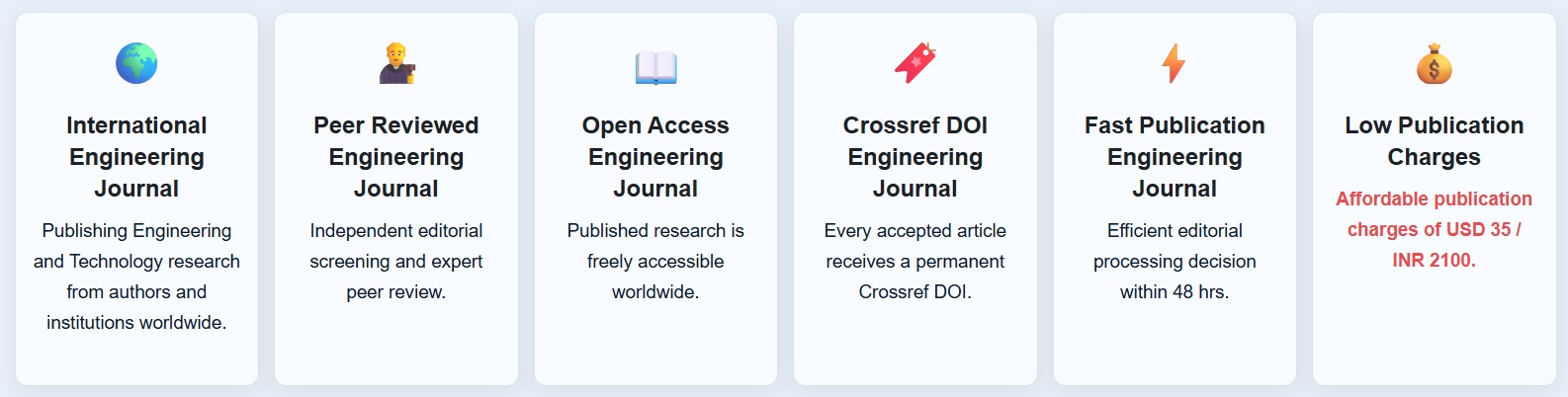
- 🌍 International Open Access Journal
- 👨⚖️ Independent Peer Review
- ⚡ Fast Editorial Processing and Publishing
- 🔗 Crossref DOI at No Additional Cost
- 📜 Free Certificate of Publication
- 💰 Low Article Processing Charges: USD 35 / INR 2100
- 📚 Broad Engineering and Technology Research Coverage
Authors should review the journal’s copyright, licensing, self-archiving, ethical publishing, and manuscript-preparation requirements before submission. Publication charges do not influence editorial screening, independent peer review, revision requirements, or acceptance decisions.
❓ Frequently Asked Questions About the Open Access Policy
1. What is the Open Access Policy of GJETA?
The Open Access Policy of the Global Journal of Engineering and Technology Advances (GJETA) explains how published articles are made freely available online while preserving copyright, licensing conditions, author attribution, ethical use, and publication integrity.
2. Does the Open Access Policy provide free access to published articles?
Yes. The Open Access Policy of the Global Journal of Engineering and Technology Advances (GJETA) allows readers to access published articles online without subscription charges or institutional access barriers.
3. Does the Open Access Policy allow readers to share articles?
The Open Access Policy allows readers to share articles published by the Global Journal of Engineering and Technology Advances (GJETA) according to the applicable licence and with accurate attribution to the authors and journal.
4. Does the Open Access Policy remove copyright restrictions?
No. The Open Access Policy of the Global Journal of Engineering and Technology Advances (GJETA) provides free access, but copyright, attribution, licensing, third-party rights, and ethical reuse requirements continue to apply.
5. How does the Open Access Policy support author visibility?
The Open Access Policy helps authors publishing with the Global Journal of Engineering and Technology Advances (GJETA) reach researchers, students, professionals, institutions, and readers worldwide without subscription barriers.
6. Does the Open Access Policy permit author self-archiving?
The Open Access Policy permits eligible self-archiving by authors of the Global Journal of Engineering and Technology Advances (GJETA) according to the journal’s Author Self-Archiving Policy, article licence, and repository requirements.
7. Does the Open Access Policy mean that all submissions are accepted?
No. The Open Access Policy of the Global Journal of Engineering and Technology Advances (GJETA) concerns public access to accepted articles. Every manuscript must still complete editorial screening, independent peer review, revision, and ethical evaluation.
8. Are publication charges separate from editorial decisions under the Open Access Policy?
Yes. The Open Access Policy confirms that publication charges at the Global Journal of Engineering and Technology Advances (GJETA) remain separate from editorial screening, reviewer selection, peer review recommendations, and final acceptance decisions.