📄 Plagiarism Policy | Global Journal of Engineering and Technology Advances (GJETA)
Protecting Originality, Proper Attribution and Research Integrity
The Global Journal of Engineering and Technology Advances (GJETA) is committed to publishing original, properly attributed, and ethically prepared scholarly research. Plagiarism undermines academic integrity, misrepresents intellectual contribution, and reduces confidence in the scholarly record. For this reason, every manuscript submitted to GJETA must represent the authors’ original work and must appropriately acknowledge all ideas, words, methods, data, figures, tables, software outputs, technical designs, and other materials obtained from existing sources.
This Plagiarism Policy explains the standards applied by GJETA when assessing originality and textual overlap in submitted or published manuscripts. It describes different forms of plagiarism, author responsibilities, editorial screening, similarity assessment, acceptable reuse, corrective actions, and the procedures followed when potential plagiarism is identified before or after publication.
🎯 Purpose of the Plagiarism Policy
The purpose of this Plagiarism Policy is to protect intellectual property, promote accurate scholarly attribution, and ensure that authors receive appropriate recognition for their original contributions. The policy also helps authors understand how previously published material may be cited, quoted, paraphrased, reused, or adapted responsibly.
GJETA recognizes that similarity between texts does not automatically prove plagiarism. Standard technical terminology, commonly used research methods, properly cited quotations, institutional names, references, and unavoidable subject-specific expressions may contribute to similarity. Editors therefore consider the nature, extent, location, context, and attribution of overlapping material before making an editorial decision.
📘 Definition of Plagiarism
Plagiarism occurs when an individual presents another person’s words, ideas, research findings, methods, data, images, technical designs, software, arguments, or intellectual contributions as their own without appropriate acknowledgment.
Plagiarism may be intentional or unintentional. However, authors remain responsible for ensuring that all borrowed material is identified clearly and cited accurately. Lack of awareness, inadequate note-taking, language difficulties, or misunderstanding of citation rules does not remove the obligation to provide proper attribution.
🚫 Forms of Plagiarism Covered by This Policy
The Plagiarism Policy of GJETA applies to different forms of unattributed or misleading reuse. These may include direct copying, inappropriate paraphrasing, duplicate publication, image plagiarism, data plagiarism, idea plagiarism, and other practices that misrepresent originality.
✔ Direct Plagiarism
Direct plagiarism occurs when text is copied word for word from another source without quotation, citation, or appropriate acknowledgment. Copying substantial portions of an article, thesis, website, report, conference paper, book, or unpublished work without attribution is unacceptable.
✔ Mosaic or Patchwork Plagiarism
Mosaic plagiarism occurs when words, phrases, sentence structures, or ideas from one or more sources are combined with limited modification while giving the impression that the resulting text is original.
Changing a few words, rearranging sentence order, or replacing terms with synonyms does not remove the requirement to cite the original source.
✔ Inadequate Paraphrasing
Paraphrasing requires authors to express source material genuinely in their own words while preserving the original meaning and providing a citation. Closely reproducing the structure, wording, or argument of a source without acknowledgment may still constitute plagiarism even when some words have been changed.
✔ Idea Plagiarism
Ideas, hypotheses, models, interpretations, methods, algorithms, technical concepts, and research approaches may require attribution even when the original wording is not copied. Presenting another researcher’s intellectual contribution as an original idea is inconsistent with responsible scholarly practice.
✔ Data Plagiarism
Using another researcher’s data, measurements, experimental results, survey responses, datasets, statistical outputs, simulation results, or technical findings without permission or acknowledgment may constitute plagiarism and research misconduct.
✔ Figure, Table and Image Plagiarism
Figures, tables, diagrams, photographs, charts, maps, technical drawings, screenshots, and other visual materials must not be copied, modified, translated, or republished without proper citation and permission where required.
✔ Source-Code and Software Plagiarism
Source code, scripts, algorithms, software modules, models, interfaces, databases, and computational tools should be acknowledged according to applicable licenses and scholarly conventions. Reusing code without attribution or presenting another developer’s work as original may constitute plagiarism.
✔ Translation Plagiarism
Translating published or unpublished material from one language into another does not make the work original. Translated words, ideas, data, or arguments must be cited and acknowledged appropriately.
🔁 Self-Plagiarism and Text Recycling
Self-plagiarism occurs when authors reuse substantial portions of their own previously published material without transparent citation or disclosure. Although authors are reusing their own work, undisclosed repetition may mislead readers about the originality and publication history of the manuscript.
Examples may include:
- reusing large sections of previously published text without citation;
- republishing the same data or conclusions as new findings;
- submitting substantially similar manuscripts to different journals;
- reusing figures, tables, or technical results without disclosure;
- dividing one study into multiple publications without scholarly justification;
- presenting previously published conference or thesis material as entirely new work without acknowledgment.
Limited reuse of standard methodological descriptions may sometimes be unavoidable, particularly when the same authors use established procedures across related studies. Such reuse should remain limited, accurately cited, and transparently explained where appropriate.
📑 Duplicate and Redundant Publication
Duplicate publication occurs when substantially the same work is published more than once without clear disclosure, citation, or editorial approval. Redundant publication may occur when the same dataset, analysis, figures, conclusions, or research population are presented across multiple articles with only minor changes.
Authors must disclose related manuscripts, previous conference versions, preprints, reports, theses, or overlapping publications when submitting their work to GJETA. Transparent disclosure allows editors to determine whether the submission contains sufficient new scholarly value.
✍️ Author Responsibilities for Originality
Authors are responsible for checking the originality and attribution of their manuscripts before submission. By submitting a manuscript to the Global Journal of Engineering and Technology Advances (GJETA), authors confirm that the work is original, appropriately referenced, and not under simultaneous consideration by another journal.
Authors should:
- cite all sources accurately and consistently;
- use quotation marks or block quotations for direct quotations where appropriate;
- paraphrase source material genuinely rather than making superficial wording changes;
- obtain permission for copyrighted content when required;
- acknowledge reused data, figures, tables, methods, software, and technical designs;
- disclose previous publications or related manuscripts;
- verify that all references correspond to the sources actually consulted;
- review the final manuscript carefully before submission.
🔍 Editorial Screening for Plagiarism
Manuscripts submitted to GJETA may be screened for textual similarity and potential plagiarism during the editorial process. Similarity screening may be conducted before peer review, during revision, before acceptance, or whenever a concern is raised.
Editorial screening may examine:
- the overall similarity percentage;
- the source and distribution of overlapping text;
- whether the overlap is cited or uncited;
- whether the copied material appears in key sections;
- whether data, images, figures, or tables have been reused;
- whether the manuscript substantially overlaps with the authors’ previous publications;
- whether multiple sources have been combined without attribution.
The journal does not rely solely on an automated similarity score. Editors evaluate the report manually because a numerical percentage cannot determine intent, context, attribution, or the seriousness of the overlap.
📌 Important Originality Principle
A low similarity score does not automatically confirm that a manuscript is free from plagiarism, and a higher score does not automatically establish misconduct. The Global Journal of Engineering and Technology Advances (GJETA) evaluates the type, extent, source, attribution, and context of overlapping content before determining the appropriate editorial action.
📊 Similarity Assessment and Editorial Evaluation
The Global Journal of Engineering and Technology Advances (GJETA) may use similarity detection software as one component of its editorial screening process. Similarity reports assist editors in identifying overlapping text, but they do not independently determine whether plagiarism has occurred.
Editorial decisions are based on professional assessment rather than a numerical similarity percentage alone. Editors evaluate the location, context, source, attribution, originality, and scholarly significance of overlapping material before deciding whether further clarification or editorial action is necessary.
📈 Understanding Similarity Reports
A similarity report identifies portions of text that resemble previously published or publicly available material. Such reports may include overlap arising from properly cited quotations, references, institutional names, standard technical terminology, legislation, equations, commonly used research methods, publicly available standards, or the authors' own previously published work.
For this reason, the journal interprets similarity reports carefully and does not use a fixed percentage as the sole basis for acceptance or rejection.
Editors may consider:
- where the overlapping text appears within the manuscript;
- whether the source has been properly cited;
- whether the overlap involves original findings or standard background information;
- whether the similarity is concentrated in one source or distributed across multiple publications;
- whether figures, tables, software, equations, or technical content have also been reused.
⚖️ No Fixed Similarity Threshold
GJETA does not apply a universal similarity percentage for all manuscripts because acceptable similarity varies according to article type, discipline, manuscript structure, and the nature of the overlapping material.
A manuscript with a relatively low similarity score may still contain serious plagiarism if copied material appears within the abstract, results, conclusions, figures, data, or original technical contribution. Conversely, a manuscript with a higher overall similarity score may remain acceptable when the overlap consists primarily of references, correctly cited quotations, methodological descriptions, or standard technical terminology.
Each manuscript is therefore evaluated individually using editorial judgement together with the available evidence.
✅ Examples of Acceptable Textual Overlap
Limited textual similarity may be acceptable in certain circumstances provided that appropriate attribution has been given and the overlap does not misrepresent the originality of the research.
Examples may include:
- properly quoted and cited passages used for scholarly discussion;
- standard descriptions of internationally accepted laboratory, engineering, computational, or analytical methods;
- technical terminology that cannot reasonably be expressed differently;
- institutional names, legislation, standards, specifications, or regulatory terminology;
- reference lists and bibliographic information;
- acknowledgement statements and funding declarations;
- ethical approval statements using standard institutional wording;
- limited reuse of previously published methodological descriptions by the same authors with appropriate citation.
❌ Examples of Unacceptable Overlap
The following situations may indicate unacceptable plagiarism or publication misconduct:
- copying large portions of text without citation;
- closely paraphrasing another publication without attribution;
- reusing figures, tables, diagrams, or images without acknowledgement;
- presenting another author's interpretation, hypothesis, or conclusions as original work;
- submitting substantially similar manuscripts to multiple journals;
- copying software code, algorithms, engineering designs, or computational models without permission or citation;
- combining text from several publications while giving the impression of original writing;
- translating published work without acknowledging the original source.
📑 Plagiarism in Different Sections of a Manuscript
Editors evaluate overlapping material according to the section of the manuscript in which it appears because some sections are more closely associated with the originality of the research.
Abstract
The abstract should be an original summary of the submitted work. Copying abstracts from previous publications, conference proceedings, reports, or theses without proper attribution is generally unacceptable.
Introduction
The introduction may discuss established knowledge and previous research, but authors should summarize the literature in their own words while providing accurate citations for the original sources.
Materials and Methods
Methodological descriptions may contain limited overlap when standard procedures are being reported. However, unnecessary copying should be avoided, and substantial reuse of previous descriptions should be cited appropriately.
Results
The results section should contain original findings generated by the reported research. Reusing previously published data, images, graphs, tables, or numerical results without transparent disclosure is not acceptable.
Discussion and Conclusions
Interpretation of results and conclusions should represent the original scholarly contribution of the submitted manuscript. Reproducing another author's discussion or conclusions without attribution constitutes plagiarism.
🎓 Previously Published Theses and Dissertations
Research derived from a thesis or dissertation may be considered for publication provided that the manuscript represents a properly prepared journal article and complies with the journal's publication policies.
Authors should disclose the relationship between the submitted manuscript and any previously deposited thesis or dissertation whenever appropriate. Significant overlap should be transparent, and the thesis should be cited where relevant.
🎤 Conference Papers and Proceedings
Research that has previously appeared in conference proceedings may be considered when the submitted manuscript provides substantial additional scholarly value, expanded analysis, significant new findings, improved methodology, or other meaningful developments beyond the earlier version.
Authors should disclose any previous conference publication during submission so that editors can evaluate the originality and contribution of the manuscript appropriately.
🌐 Preprints and Public Repositories
Where permitted by journal policy, manuscripts previously deposited as preprints may be considered for publication. Authors should disclose the existence of the preprint during submission and update the preprint record appropriately after publication when required.
Publication of a manuscript in GJETA does not remove the author's responsibility to provide accurate attribution between the published article and any earlier publicly available version.
©️ Copyrighted Material and Permissions
Authors are responsible for obtaining permission to reuse copyrighted figures, tables, images, diagrams, maps, illustrations, questionnaires, software outputs, or other protected material whenever permission is required by the copyright holder.
Obtaining permission does not remove the requirement to provide appropriate scholarly citation and acknowledgment of the original source.
📨 Editorial Actions Before Publication
When potential plagiarism is identified before publication, editors may take actions appropriate to the seriousness of the concern and the available evidence.
Possible editorial actions include:
- requesting clarification from the authors;
- requiring correction of citations or references;
- requesting substantial rewriting of overlapping sections;
- requesting permission documentation for reused material;
- requiring disclosure of related publications;
- requesting original files, datasets, or supporting documentation;
- returning the manuscript for major revision;
- rejecting the manuscript when serious plagiarism or publication misconduct is confirmed.
The editorial response will always consider the nature of the overlap, the level of attribution provided, the originality of the research, and the overall integrity of the submitted manuscript.
⚠️ Editorial Actions After Publication
If potential plagiarism is identified after an article has been published, the Global Journal of Engineering and Technology Advances (GJETA) will evaluate the concern carefully and fairly. The journal aims to protect the integrity of the scholarly record while ensuring that authors are given an appropriate opportunity to respond.
The editorial response depends on the seriousness, extent, context, and impact of the identified overlap. Each case is assessed individually using the available evidence rather than applying an automatic or predetermined outcome.
🔍 Investigation of Plagiarism Allegations
Allegations of plagiarism may be submitted by authors, reviewers, readers, editors, research institutions, publishers, or other stakeholders. Reports should clearly identify the publication concerned and provide sufficient supporting information to enable an impartial editorial assessment.
During an investigation, the journal may:
- review the similarity report and the original sources;
- compare the overlapping material with the submitted or published article;
- request an explanation from the corresponding author;
- seek clarification from co-authors where appropriate;
- request original files, datasets, laboratory records, software, or supporting documentation;
- consult editorial board members or independent subject experts;
- contact the relevant institution, funding agency, or research integrity office when necessary.
The objective of the investigation is to establish the facts objectively and determine the most appropriate editorial response while maintaining fairness, confidentiality, and transparency.
📝 Author Response and Clarification
When a plagiarism concern is raised, authors are normally provided with an opportunity to explain the circumstances before an editorial decision is made. Authors may be asked to clarify citations, identify the source of overlapping material, provide permission documentation, or explain similarities with previous publications.
A prompt, complete, and evidence-based response assists the editorial office in evaluating the concern efficiently. Failure to respond or provide requested information may influence the editorial outcome.
✏️ Corrections and Article Updates
Where plagiarism concerns involve limited attribution errors or other issues that do not invalidate the main scholarly contribution of the article, the journal may consider issuing a correction or other editorial update.
Possible situations include:
- missing or incomplete references;
- incorrect attribution of figures or tables;
- omitted acknowledgements;
- citation errors affecting scholarly attribution;
- other correctable issues that do not compromise the reliability of the research findings.
Correction notices should clearly describe the changes made while preserving the transparency and integrity of the publication record.
⛔ Retraction for Serious Plagiarism
Retraction may be considered when plagiarism substantially affects the originality, reliability, authorship, or integrity of a published article. Serious plagiarism may include extensive unattributed copying, duplicate publication, misappropriation of another person's intellectual work, or deliberate attempts to misrepresent previously published material as original research.
Retraction decisions are made only after appropriate editorial review and consideration of the available evidence. Where appropriate, the journal may also communicate with the relevant institution or research integrity authority.
🖼️ Image, Figure and Multimedia Plagiarism
Plagiarism is not limited to written text. Figures, photographs, diagrams, engineering drawings, graphical abstracts, maps, flowcharts, videos, animations, screenshots, and other visual materials are also protected intellectual works.
Authors should not:
- copy published figures without citation and permission where required;
- modify or crop images to disguise their origin;
- reuse photographs or diagrams while claiming they were newly created;
- present images generated for another study as part of new research;
- remove watermarks, attribution, or copyright information.
All reused visual material should be properly acknowledged, and any required permissions should be obtained before publication.
💻 Software, Code and Algorithm Plagiarism
Engineering and technology research frequently includes software, source code, computational models, artificial intelligence workflows, algorithms, databases, simulation programs, and digital tools. These materials should be treated with the same respect for intellectual property as traditional scholarly publications.
Authors should acknowledge existing software, open-source projects, algorithms, libraries, datasets, and computational resources according to their applicable licenses, citation recommendations, and scholarly conventions.
Unauthorized copying or misrepresentation of software or computational work may constitute plagiarism even when only limited textual similarity is present.
🤖 Artificial Intelligence and Plagiarism
The use of artificial intelligence tools does not remove the author's responsibility for originality and accurate attribution. Authors remain fully responsible for ensuring that all submitted content complies with the journal's publication ethics and plagiarism requirements.
Authors should not use artificial intelligence systems to generate or reproduce copyrighted, confidential, or previously published material without appropriate authorization or attribution. AI-generated text should also be reviewed carefully to ensure that it does not unintentionally reproduce existing published content.
Additional guidance is available in the journal's AI Usage Policy.
📚 Citation Integrity and Proper Attribution
Accurate citation is an essential element of responsible scholarly publishing. Every source that directly influences a manuscript should be acknowledged appropriately so that readers can identify the origin of ideas, methods, evidence, and previous research.
Authors should avoid:
- omitting relevant citations;
- citing sources that were not consulted;
- misrepresenting another author's conclusions;
- providing inaccurate bibliographic information;
- adding unnecessary citations solely to increase citation counts.
Proper citation strengthens scholarly transparency while allowing readers to evaluate the development of knowledge within the research field.
👨🔬 Responsibilities of Authors
Authors are responsible for ensuring the originality of their submitted work and should carefully review the manuscript before submission.
Authors should:
- prepare original manuscripts;
- acknowledge all relevant sources accurately;
- obtain required permissions for copyrighted material;
- disclose previous publications and related manuscripts;
- respond promptly to editorial questions regarding originality;
- cooperate fully during plagiarism investigations.
👨⚖️ Responsibilities of Reviewers
Reviewers contribute to publication integrity by identifying possible plagiarism, duplicate publication, inappropriate attribution, image reuse, citation manipulation, or other originality concerns encountered during peer review.
Suspected concerns should be reported confidentially to the editor together with supporting observations whenever possible.
👨💼 Responsibilities of Editors
Editors are responsible for evaluating similarity reports, assessing allegations fairly, communicating with authors, consulting reviewers or experts when required, and determining appropriate editorial actions consistent with the Publication Ethics Policy.
Editorial decisions should remain objective, evidence-based, and independent of commercial or personal considerations.
🛡️ Policy Enforcement
The editorial response to plagiarism depends upon the seriousness of the concern and the available evidence. Possible actions may include:
- requesting manuscript revision;
- requiring additional citations or acknowledgements;
- requesting permission documentation;
- rejecting the manuscript;
- issuing a published correction;
- publishing an expression of concern;
- retracting a published article;
- informing the relevant institution or funding body when appropriate;
- restricting future submissions in cases of confirmed serious misconduct.
Each case is assessed individually to ensure that editorial actions remain proportionate, transparent, and consistent with accepted standards of publication ethics.
📌 Editorial Principle
The Global Journal of Engineering and Technology Advances (GJETA) is committed to protecting original scholarship while ensuring that plagiarism concerns are investigated fairly, confidentially, and objectively. Editorial decisions are based on evidence, proper attribution, publication ethics, and the overall integrity of the scholarly record.
🌟 Why the Plagiarism Policy Matters
A comprehensive Plagiarism Policy helps protect the originality, credibility, and long-term value of scholarly publications. It provides clear expectations for authors while supporting editors and reviewers in maintaining high standards of academic integrity throughout the publication process.
For the Global Journal of Engineering and Technology Advances (GJETA), preventing plagiarism is essential for ensuring that published engineering, technology, applied science, and interdisciplinary research accurately reflects the genuine intellectual contributions of researchers. Responsible attribution promotes scholarly trust, protects intellectual property, and strengthens confidence in published research.
The Plagiarism Policy helps GJETA:
- promote original scholarly research and responsible academic writing;
- protect intellectual property and author contributions;
- encourage proper citation and transparent attribution;
- prevent duplicate publication and text recycling;
- support fair editorial and peer review decisions;
- maintain the integrity of the scholarly record;
- strengthen confidence among authors, reviewers, readers, and institutions.
🔗 Related GJETA Editorial and Publishing Policies
The Plagiarism Policy should be read together with the following editorial and publishing policies of the Global Journal of Engineering and Technology Advances to understand the journal's complete framework for ethical scholarly publishing.
🚀 Publish Original Research with GJETA
The Global Journal of Engineering and Technology Advances (GJETA) welcomes original research articles, review papers, technical papers, case studies, and interdisciplinary research that demonstrate academic integrity, technical quality, and responsible scholarly conduct.
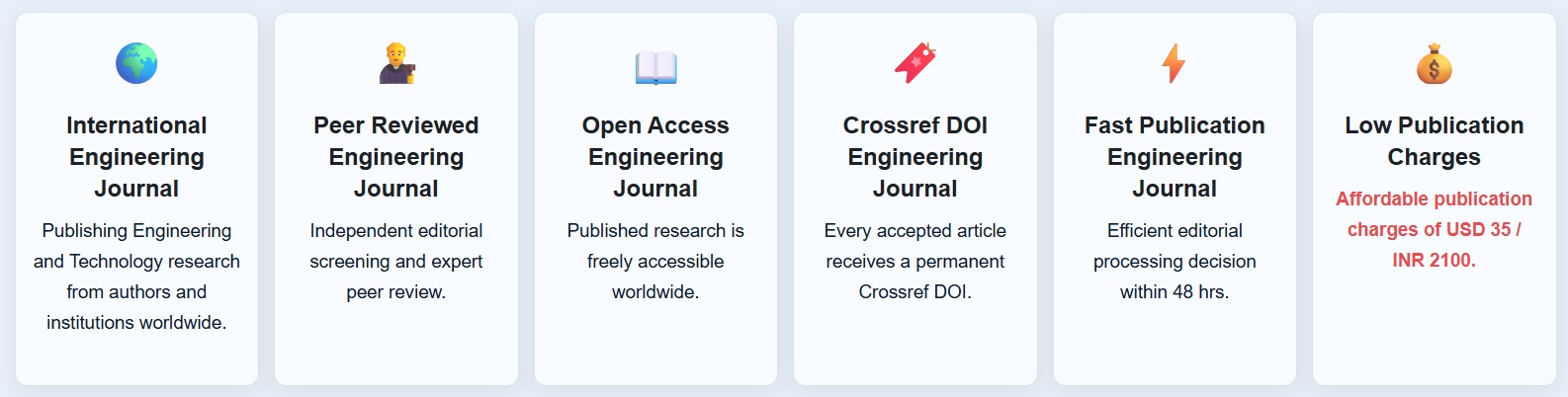
- 🌍 International Open Access Journal
- 👨⚖️ Independent Peer Review
- ⚡ Fast Editorial Processing and Publishing
- 🔗 Crossref DOI at No Additional Cost
- 📜 Free Certificate of Publication
- 💰 Low Article Processing Charges: USD 35 / INR 2100
- 📚 Broad Engineering and Technology Research Coverage
Authors are encouraged to verify originality, provide accurate citations, and review all ethical declarations before submitting their manuscripts. Editorial decisions are based on academic merit, technical quality, originality, ethical compliance, and the journal's publication standards.
❓ Frequently Asked Questions About the Plagiarism Policy
1. What is the Plagiarism Policy of GJETA?
The Plagiarism Policy of the Global Journal of Engineering and Technology Advances (GJETA) explains the journal's requirements for originality, proper attribution, responsible citation, similarity assessment, editorial evaluation, and the handling of plagiarism before or after publication.
2. Why is the Plagiarism Policy important for authors?
The Plagiarism Policy helps authors understand how the Global Journal of Engineering and Technology Advances (GJETA) evaluates originality, interprets similarity reports, and expects proper citation of text, figures, data, software, and other scholarly material.
3. Does the Plagiarism Policy use a fixed similarity percentage?
No. The Plagiarism Policy of the Global Journal of Engineering and Technology Advances (GJETA) does not rely solely on a numerical similarity score. Editors assess the context, location, attribution, and significance of overlapping material before making an editorial decision.
4. How does the Plagiarism Policy address self-plagiarism?
The Plagiarism Policy requires authors submitting to the Global Journal of Engineering and Technology Advances (GJETA) to disclose previous publications and avoid undisclosed text recycling, duplicate publication, or redundant reporting of the same research.
5. What types of plagiarism are covered by the Plagiarism Policy?
The Plagiarism Policy of the Global Journal of Engineering and Technology Advances (GJETA) covers direct plagiarism, mosaic plagiarism, inadequate paraphrasing, idea plagiarism, data plagiarism, image plagiarism, software plagiarism, translation plagiarism, and self-plagiarism.
6. What happens if plagiarism is identified under the Plagiarism Policy?
Depending on the seriousness of the concern, the Global Journal of Engineering and Technology Advances (GJETA) may request clarification, require revisions, reject the manuscript, issue a correction, publish an expression of concern, retract an article, or take other appropriate editorial action.
7. Does the Plagiarism Policy apply after publication?
Yes. The Plagiarism Policy continues to apply after publication. If credible evidence of plagiarism is identified, the Global Journal of Engineering and Technology Advances (GJETA) may investigate the matter and take appropriate post-publication action.
8. How can plagiarism concerns be reported under the Plagiarism Policy?
Plagiarism concerns may be reported to the Global Journal of Engineering and Technology Advances (GJETA) through the journal's official communication channels. Reports should identify the relevant manuscript or article and include supporting evidence whenever possible.