✏️ Correction Policy | Global Journal of Engineering and Technology Advances (GJETA)
Maintaining the Accuracy, Transparency and Reliability of Published Research
The Global Journal of Engineering and Technology Advances (GJETA) is committed to preserving the accuracy, integrity, and transparency of the scholarly record. Although manuscripts undergo editorial screening, independent peer review, author revision, proofreading, and production checks, errors may occasionally be identified after publication. When a published error affects the accuracy, interpretation, attribution, discoverability, or presentation of an article, the journal may issue an appropriate correction or publication update.
This Correction Policy explains how GJETA receives, evaluates, documents, and publishes corrections relating to articles, author details, data, figures, tables, references, metadata, disclosures, supplementary files, and other elements of the publication record. It also clarifies the difference between minor updates, formal corrections, expressions of concern, retractions, and exceptional article removal.
🎯 Purpose of the Correction Policy
The purpose of this Correction Policy is to ensure that errors in published content are addressed fairly, promptly, transparently, and proportionately. Correcting the literature helps readers rely on accurate information while preserving the history and integrity of the original publication.
The policy helps GJETA:
- maintain accurate and reliable published articles;
- correct errors without obscuring the publication history;
- distinguish minor mistakes from errors affecting research conclusions;
- provide transparent notices linked to affected articles;
- update article metadata and indexing records where necessary;
- protect authors, readers, institutions, and the scholarly community;
- preserve confidence in engineering and technology research.
📘 Meaning of a Published Correction
A published correction is a formal notice that identifies and amends an error in an article while allowing the article to remain part of the scholarly record. A correction is appropriate when the published work remains substantially reliable but contains information that should be clarified, replaced, or amended.
A correction may address:
- factual errors;
- incorrect data values;
- mistakes in figures or tables;
- author name or affiliation errors;
- omitted declarations or acknowledgements;
- reference and citation errors;
- incorrect article metadata;
- minor methodological or interpretative inaccuracies;
- errors in supplementary material.
⚖️ Principles Governing Corrections
Corrections should be guided by accuracy, proportionality, transparency, accessibility, and preservation of the scholarly record.
The principal correction standards followed by GJETA include:
- significant errors should not remain unaddressed;
- corrections should explain what was wrong and what has been amended;
- the correction should remain linked to the original article;
- the original publication date and article identity should be preserved;
- corrections should not conceal misconduct or unreliable research;
- minor typographical changes should not create unnecessary formal notices;
- the response should be proportionate to the effect of the error.
🔍 Sources of Correction Requests
Potential errors may be identified by:
- authors;
- editors or editorial staff;
- peer reviewers;
- readers;
- research institutions;
- funders;
- indexing or metadata services;
- copyright holders;
- other journals or publishers.
Anyone reporting an error should identify the affected article, explain the concern clearly, and provide supporting evidence where available.
👨🔬 Author Responsibility for Reporting Errors
Authors are expected to notify GJETA promptly when they discover a meaningful error or omission in their published work.
Authors should provide:
- the article title and DOI;
- a description of the error;
- the exact location of the affected content;
- the proposed corrected wording, value, figure, table, or declaration;
- an explanation of whether the error affects the results or conclusions;
- confirmation from all authors where appropriate;
- supporting data or documentation when required.
📝 Minor Errors and Silent Updates
Very minor errors that do not affect meaning, interpretation, attribution, citation, indexing, or the scientific record may sometimes be corrected without publishing a separate formal notice.
Examples may include:
- obvious spelling mistakes;
- minor punctuation errors;
- formatting inconsistencies;
- broken internal links;
- non-substantive layout issues;
- minor typographical errors that cannot mislead readers.
Silent changes should not be used when the amendment affects scientific meaning, data, authorship, disclosures, conclusions, or other material aspects of the article.
📢 Formal Correction Notices
A formal correction notice is appropriate when an error affects the article meaningfully but does not invalidate the main findings.
A correction notice should normally:
- identify the original article clearly;
- include the article title, authors, citation, and DOI;
- describe the original error;
- provide the corrected information;
- state whether the conclusions are affected;
- remain permanently accessible;
- link electronically to the original article.
🧾 Types of Correction Notices
Depending on the source and nature of the error, a correction may be described using terminology such as:
- Author Correction: issued when an error originated from the authors;
- Publisher Correction: issued when an error arose during editing, formatting, typesetting, metadata preparation, or publication;
- Editorial Correction: issued when an editorial statement, policy reference, or journal-generated element requires amendment.
The terminology used may vary according to the circumstances, but the notice should always explain the correction clearly.
📌 Scholarly Record Principle
The Global Journal of Engineering and Technology Advances (GJETA) corrects published errors in a transparent manner while preserving the original article identity, publication history, DOI, and connection between the article and its correction notice.
👤 Corrections to Author Names and Affiliations
Accurate author names and institutional affiliations are important for attribution, indexing, citation tracking, academic recognition, and research accountability.
A correction may be considered when:
- an author name is misspelled;
- the order of given and family names is incorrect;
- an institutional affiliation is inaccurate;
- an author identifier is incorrect or missing;
- the corresponding author information is wrong;
- a legitimate authorship change is approved after publication.
Substantive additions, removals, or reordering of authors must comply with the journal’s Authorship Policy and may require confirmation from all affected authors or institutional review.
📊 Corrections to Data and Numerical Results
Errors in data values, calculations, measurements, sample sizes, statistics, units, percentages, or reported results may require formal correction when readers could otherwise be misled.
The journal may request:
- original or raw data;
- corrected calculations;
- revised statistical outputs;
- updated tables or figures;
- an explanation of how the error occurred;
- confirmation of whether the conclusions remain valid.
If corrected data materially change the principal conclusions or make the findings unreliable, retraction or another stronger action may be necessary.
📈 Corrections to Figures, Graphs and Tables
A formal correction may be required when a figure, graph, table, diagram, map, or image contains inaccurate labels, missing information, incorrect values, duplicated elements, formatting errors, or an inappropriate source file.
The corrected notice may include:
- a replacement figure or table;
- revised labels, legends, units, or captions;
- an explanation of the affected content;
- a statement regarding the effect on results and conclusions;
- updated supplementary material where applicable.
🖼️ Image-Related Corrections
Errors involving photographs, microscopy images, screenshots, engineering drawings, or other visual evidence should be evaluated carefully.
A correction may be appropriate when:
- the wrong image was inserted accidentally;
- an image label or caption is incorrect;
- a panel was duplicated unintentionally;
- an image adjustment was reported incompletely;
- the original data remain available and the correct image supports the same conclusion.
Retraction or an expression of concern may be necessary when image manipulation or replacement makes the research findings unreliable.
📚 Corrections to References and Citations
Reference corrections may be issued when citation errors affect attribution, source verification, interpretation, or scholarly credit.
Examples include:
- incorrect author names or article titles;
- wrong journal, volume, issue, or page details;
- incorrect DOI information;
- citation of the wrong source;
- omission of a reference essential for attribution;
- references generated inaccurately through automated or AI-assisted tools.
Minor reference formatting differences that do not interfere with source identification may not require a formal correction.
📄 Corrections to Methods and Technical Descriptions
Errors in methodological or technical descriptions may require correction when they affect understanding, reproducibility, interpretation, or safe application of the research.
A correction may clarify:
- experimental procedures;
- equipment specifications;
- software versions;
- algorithm parameters;
- sample preparation;
- engineering design conditions;
- statistical procedures;
- measurement units;
- data preprocessing methods.
🧠 Corrections to Discussion and Interpretation
Authors may request correction when the discussion contains an inaccurate explanation, unsupported statement, incorrectly described limitation, or misleading interpretation that does not invalidate the study’s principal findings.
The journal will assess whether:
- the corrected interpretation is supported by the data;
- the central conclusions remain reliable;
- the change is a clarification rather than a new argument;
- the amendment would substantially alter the article’s scholarly contribution.
📌 Corrections to Conclusions
A correction may be considered when limited wording in the conclusion requires clarification but the main findings remain valid.
If the corrected evidence requires major reversal, withdrawal, or abandonment of the article’s principal conclusions, a correction may be insufficient and retraction should be considered.
⚠️ Corrections to Ethical Approvals and Consent Statements
Errors or omissions involving ethical approval, informed consent, institutional permission, participant protection, animal research approval, or regulatory compliance require careful evaluation.
A correction may be appropriate when:
- the approval number was entered incorrectly;
- the correct institution was omitted;
- a valid consent statement was not included during production;
- an approval existed but was described inaccurately.
If required ethical approval or consent did not exist, a correction may not be sufficient and stronger editorial action may be necessary.
💰 Corrections to Funding and Conflict of Interest Statements
Incomplete or inaccurate funding, sponsorship, patent, consultancy, employment, or competing-interest declarations may require a formal correction.
The correction should clarify:
- the funding source;
- grant or project information;
- the role of the sponsor;
- the relevant financial or professional relationship;
- whether the omission affected editorial or research independence.
🙏 Corrections to Acknowledgements and Contributor Statements
A correction may add, remove, or amend an acknowledgement, contributor role, technical-support credit, or institutional recognition when the published information is inaccurate or incomplete.
Changes affecting authorship eligibility must be handled under the Authorship Policy rather than treated only as an acknowledgement correction.
📎 Corrections to Supplementary Material
Supplementary datasets, files, appendices, code, videos, figures, tables, questionnaires, or technical documentation may require correction when they contain an error or do not correspond with the published article.
The journal may replace the affected file while preserving:
- the relationship with the original article;
- the date of correction;
- a record of what changed;
- the article DOI and publication metadata;
- access to the correction notice.
🔗 Corrections to DOI, Metadata and Indexing Information
Incorrect metadata can affect article discovery, citation, indexing, and author recognition.
Metadata corrections may include:
- author names;
- article title;
- abstract or keywords;
- volume, issue, pages, or article number;
- publication date;
- DOI registration information;
- copyright or licence details;
- funding metadata.
Where necessary, the journal may send updated information to Crossref, indexing services, repositories, libraries, or other scholarly platforms.
🔍 Editorial Assessment of Correction Requests
Every correction request is evaluated according to the nature, seriousness, evidence, and effect of the reported error.
The editorial team may consider:
- whether an error actually exists;
- whether the issue affects meaning or interpretation;
- whether the original data support the proposed correction;
- whether all authors agree;
- whether the findings remain reliable;
- whether misconduct or ethical concerns may be involved;
- whether a correction is sufficient to protect readers.
📨 Information Requested from Authors
The journal may ask authors to provide:
- a detailed explanation of the error;
- the corrected text or replacement material;
- original data or source files;
- revised calculations;
- author approval;
- ethical or institutional documentation;
- confirmation regarding the effect on conclusions;
- a proposed correction statement.
👨⚖️ Independent Review of Corrections
A correction involving scientific, technical, statistical, ethical, or methodological issues may be reviewed by:
- the handling editor;
- an editorial board member;
- the original peer reviewers;
- an independent subject expert;
- a statistician, methodologist, or technical specialist;
- an institutional research-integrity office.
Independent review helps determine whether the proposed correction is adequate and whether the article remains reliable.
📢 Reader and Third-Party Correction Requests
Readers, institutions, funders, or other parties may report suspected errors in a published article.
A report should include:
- the article title or DOI;
- the exact location of the suspected error;
- an explanation of the concern;
- supporting evidence or references;
- contact information where appropriate.
The journal may contact the authors and relevant experts before deciding whether a correction is required.
📝 Author Agreement and Disagreement
The journal will normally seek the views of all authors when a substantial correction is proposed. However, author disagreement does not automatically prevent correction when the evidence clearly shows that the publication record is inaccurate.
If authors cannot agree, GJETA may:
- request individual statements;
- consult the relevant institution;
- publish a correction that explains the available evidence;
- issue an expression of concern while the matter is investigated;
- take other action necessary to protect readers.
🔄 Updating the Original Article
Where technically and editorially appropriate, the online article may be updated to reflect the correction.
The article should:
- indicate that it has been corrected;
- display the date of the update;
- link to the formal correction notice;
- preserve the article DOI;
- avoid concealing the original publication history.
🔖 DOI and Citation of Correction Notices
A formal correction notice may receive its own citation details and DOI so that it can be indexed, cited, linked, and preserved as part of the scholarly record.
The notice should link to the original article, and the original article should link back to the notice.
⚠️ Expression of Concern
An expression of concern may be issued when serious questions exist but the available evidence is incomplete, disputed, or subject to an institutional or legal investigation.
An expression of concern may be appropriate when:
- the reliability of the article is uncertain;
- authors provide conflicting explanations;
- original data are unavailable;
- an institution is investigating misconduct;
- a correction cannot yet be confirmed;
- readers should be warned while the investigation continues.
⛔ When a Correction Is Not Sufficient
A correction is not appropriate when the article’s findings are fundamentally unreliable or when serious misconduct affects the publication as a whole.
Retraction may be considered when:
- data were fabricated or falsified;
- major conclusions are invalid;
- substantial plagiarism is confirmed;
- peer review was manipulated;
- research was conducted without essential ethical approval;
- duplicate publication materially affects the record;
- the article cannot be corrected without replacing its central findings.
Such cases are handled under the journal’s Retraction Policy.
🗑️ Exceptional Article Removal
Article removal is considered only in exceptional circumstances, such as serious legal restrictions, privacy violations, immediate safety risks, court orders, or content whose continued availability would cause substantial harm.
Where possible, a bibliographic record and removal notice should remain available to preserve transparency.
📚 Correction of Retracted Articles
A retracted article may still require correction of bibliographic or factual details in the retraction notice or metadata. However, correcting limited information does not reverse the retraction unless a formal editorial review determines that the original retraction was incorrect.
🏛️ Institutional Findings and Corrections
When a research institution, ethics committee, funder, or regulatory body provides findings relevant to a published error, GJETA may consider those findings when determining the appropriate correction or post-publication action.
The journal retains responsibility for the final publication decision affecting its own scholarly record.
📣 Complaints and Appeals
Authors or other affected parties may appeal a correction decision when they believe:
- the error was misunderstood;
- important evidence was overlooked;
- the correction wording is inaccurate;
- the action is disproportionate;
- a procedural error affected the outcome.
An appeal should provide clear reasons and supporting documentation. Where appropriate, it may be reviewed by an editor or expert who was not involved in the original decision.
🛠️ Enforcement of the Correction Policy
The editorial response depends on the nature, seriousness, evidence, and effect of the error.
Possible actions include:
- making a minor non-substantive update;
- publishing an author, publisher, or editorial correction;
- updating figures, tables, supplementary files, or metadata;
- requesting additional expert review;
- publishing an expression of concern;
- retracting an unreliable article;
- contacting an institution, funder, ethics committee, or responsible authority;
- updating Crossref and indexing records.
📌 Proportional Response Principle
The Global Journal of Engineering and Technology Advances (GJETA) applies the least severe editorial action capable of correcting the published record accurately. Minor errors may require limited amendment, while serious reliability concerns may require an expression of concern or retraction.
🌟 Why the Correction Policy Matters
A clear Correction Policy shows that published research remains subject to responsible review and amendment after publication. Correcting genuine errors protects readers, improves article accuracy, supports reliable citation, and strengthens confidence in scholarly communication.
For the Global Journal of Engineering and Technology Advances (GJETA), correction procedures are especially important because engineering and technology articles may contain equations, measurements, software parameters, technical specifications, algorithms, datasets, figures, simulations, and practical recommendations that readers may rely upon.
The Correction Policy helps GJETA:
- maintain accurate published research;
- correct errors without erasing publication history;
- protect the integrity of article metadata and DOI records;
- clarify authorship, funding, ethics, and disclosure information;
- update figures, tables, data, references, and supplementary files;
- distinguish correctable errors from unreliable research;
- connect corrections permanently with the affected article;
- strengthen reader confidence in the journal.
🔗 Related GJETA Editorial and Publishing Policies
Authors, reviewers, editors, readers, and institutions are encouraged to review the following policies of the Global Journal of Engineering and Technology Advances for a complete understanding of corrections, retractions, publication ethics, data integrity, authorship, withdrawal, and article updates.
🚀 Publish Accurate and Responsible Research with GJETA
The Global Journal of Engineering and Technology Advances (GJETA) welcomes original research articles, review papers, technical studies, software research, case studies, short communications, and interdisciplinary manuscripts prepared with accurate data, complete declarations, and responsible publication practices.
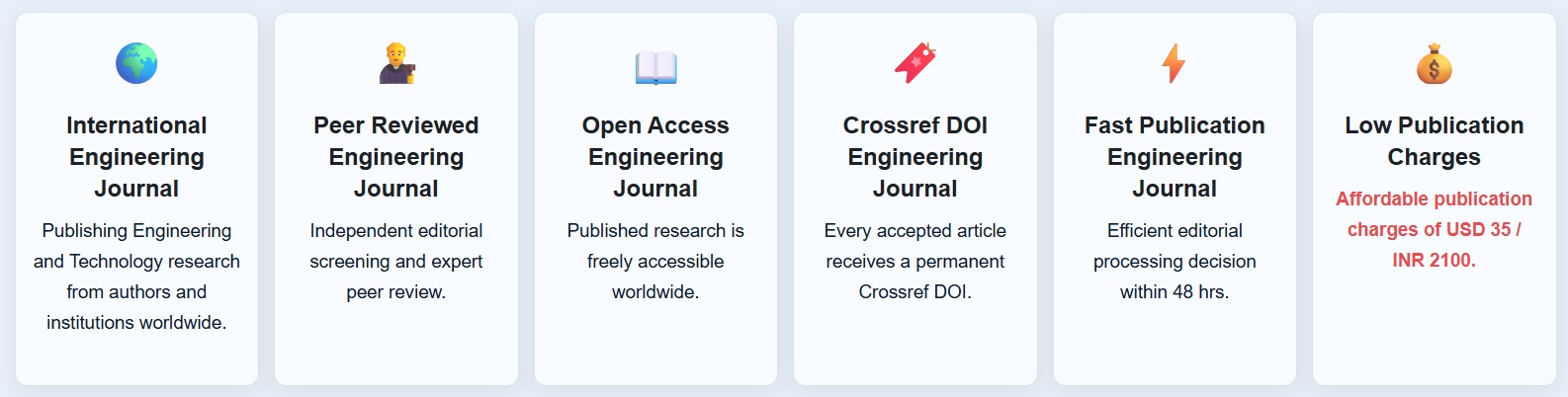
- 🌍 International Open Access Journal
- 👨⚖️ Independent Peer Review
- ⚡ Fast Editorial Processing and Publishing
- 🔗 Crossref DOI at No Additional Cost
- 📜 Free Certificate of Publication
- 💰 Low Article Processing Charges: USD 35 / INR 2100
- 📚 Broad Engineering and Technology Research Coverage
Authors should verify their manuscript carefully before submission and promptly report any meaningful error identified after publication. Publication charges do not influence editorial screening, independent peer review, correction decisions, or acceptance.
❓ Frequently Asked Questions About the Correction Policy
1. What is the Correction Policy of GJETA?
The Correction Policy of the Global Journal of Engineering and Technology Advances (GJETA) explains how the journal evaluates and corrects errors in published articles, author details, data, figures, tables, references, disclosures, supplementary files, and metadata.
2. What errors are covered by the Correction Policy?
The Correction Policy of the Global Journal of Engineering and Technology Advances (GJETA) covers factual mistakes, numerical errors, incorrect figures or tables, author and affiliation errors, reference problems, missing declarations, metadata issues, and other correctable publication inaccuracies.
3. Does every minor mistake require a formal Correction Policy notice?
No. Under the Correction Policy, the Global Journal of Engineering and Technology Advances (GJETA) may correct very minor spelling, punctuation, formatting, or technical issues without a formal notice when they do not affect meaning, attribution, interpretation, or the scholarly record.
4. How can authors request action under the Correction Policy?
Under the Correction Policy, authors should contact the Global Journal of Engineering and Technology Advances (GJETA) with the article title, DOI, location of the error, corrected information, supporting evidence, and an explanation of whether the conclusions are affected.
5. Does the Correction Policy allow correction of author names?
Yes. The Correction Policy of the Global Journal of Engineering and Technology Advances (GJETA) allows correction of author names, affiliations, correspondence details, and approved authorship information when the published record is inaccurate.
6. How does the Correction Policy address incorrect data or figures?
The Correction Policy allows the Global Journal of Engineering and Technology Advances (GJETA) to publish corrected values, calculations, figures, tables, captions, or supplementary files when the main findings remain reliable.
7. When is the Correction Policy insufficient to protect the published record?
The Correction Policy may be insufficient when the principal findings of a Global Journal of Engineering and Technology Advances (GJETA) article are unreliable because of fabrication, falsification, serious methodological error, plagiarism, unethical research, or another major integrity concern.
8. Does the Correction Policy preserve the original article DOI?
Yes. The Correction Policy of the Global Journal of Engineering and Technology Advances (GJETA) normally preserves the original article DOI and publication history while linking the article clearly to its correction notice and updated record.