📑 Journal Policies | Global Journal of Engineering and Technology Advances (GJETA)
Transparent Editorial, Publishing and Author Policies
The Global Journal of Engineering and Technology Advances (GJETA) is committed to maintaining transparency, ethical publishing standards, responsible academic practices, editorial independence, and the integrity of the scholarly record.
The following journal policies outline the terms, conditions, procedures, and guidelines governing manuscript submission, peer review, publication, research integrity, privacy, author responsibilities, article access, corrections, withdrawals, and post-publication actions.
Authors, reviewers, editors, readers, institutions, and website users are advised to review the relevant policies carefully before proceeding with manuscript submission, peer review, payment, publication, article reuse, or any other interaction with GJETA.
📋 General Policies of GJETA
The general policies below apply to authors, reviewers, readers, editors, and other users interacting with the Global Journal of Engineering and Technology Advances.
1. Terms and Conditions
By submitting an initial or final manuscript to GJETA, the author or authors confirm their agreement with the journal’s editorial, ethical, legal, and publication requirements.
- The submitted manuscript must be original, unpublished, appropriately referenced, and free from plagiarism.
- The manuscript must not be under simultaneous consideration by another journal at the time of submission.
- All listed authors must have reviewed and approved the manuscript before submission.
- Authors must obtain any necessary approval or consent from their institution, employer, supervisor, research committee, ethics committee, funder, or other responsible authority.
- All co-authors must consent to submission and publication.
- The author list, author order, affiliations, declarations, and contributor information must be accurate.
- Authors must disclose relevant conflicts of interest, funding, sponsorship, ethical approval, data availability, and the use of artificial intelligence where required.
- All communications exchanged during editorial processing and peer review should be treated responsibly and confidentially. Private editorial correspondence should not be published, circulated, or misrepresented without appropriate permission.
- Authors are responsible for responding accurately and promptly to editorial, peer review, ethical, production, and post-publication enquiries.
- Post-publication correction requests may be subject to applicable administrative or correction charges where communicated by the journal. Corrections are normally considered through a single consolidated request unless an additional amendment is required to protect the scholarly record.
- Where proven copyright infringement or another serious legal concern affects a published article, GJETA may correct, restrict, retract, or remove the affected content in accordance with its editorial policies and applicable legal requirements.
- Publication fees are generally non-refundable after substantial editorial, peer review, production, metadata, DOI, or publication services have been completed, except where the journal determines otherwise.
- Institutional rejection, employer objection, academic assessment, promotion outcome, visa decision, funding decision, or another third-party action after publication does not normally create an entitlement to a refund.
- Authors remain responsible for the content, accuracy, originality, data integrity, ethical compliance, legal permissions, references, figures, tables, software, and conclusions of their work.
- Payment of publication charges does not guarantee acceptance and does not influence editorial screening, reviewer selection, peer review recommendations, revision requirements, or final decisions.
- Submission of a manuscript does not create a contractual guarantee of publication, indexing, citation, institutional acceptance, academic recognition, or professional benefit.
- Authors should retain copies of all manuscript files, supporting data, permissions, ethical approvals, payment records, and journal correspondence.
All eligible submissions undergo editorial assessment and independent peer review. Editorial decisions are based on manuscript quality, originality, technical merit, ethical compliance, reviewer recommendations, and relevance to the journal’s scope. The final publication decision remains with the authorised editorial team.
2. Privacy Policy
GJETA is committed to protecting the privacy and confidentiality of authors, reviewers, editors, readers, and website users. Personal information is collected and processed only for legitimate journal, editorial, publishing, administrative, technical, communication, and legal purposes.
Information Collected
- Name and professional details
- Email address and contact information
- Institutional affiliation and designation
- Author and reviewer profile information
- Manuscript submission details
- Editorial and peer review correspondence
- Payment and transaction-related records where applicable
- Website usage or technical information necessary for journal operation
- Other information voluntarily provided during submission, review, registration, or communication
Use of Information
- Manuscript submission and editorial processing
- Peer reviewer selection and communication
- Publication, metadata preparation, DOI registration, indexing, and archiving
- Internal record-keeping and quality control
- Verification of author, reviewer, or editorial identity
- Processing publication-related payments and records
- Improving journal services and website functionality
- Sending relevant editorial notices, publication updates, announcements, or related information
- Handling complaints, appeals, corrections, retractions, ethical concerns, and legal obligations
- Preventing fraud, misuse, impersonation, duplicate submission, and other publication misconduct
Personal information will not be sold to third parties. Information may be shared only when reasonably necessary for journal operations, peer review, publication, indexing, payment processing, technical support, legal compliance, research-integrity investigations, or protection of legitimate rights.
Author names, affiliations, article metadata, declarations, and contact details intended for publication may become publicly available as part of the scholarly record.
Reviewers, editors, and journal staff are expected to protect confidential manuscript and personal information. However, absolute security of electronic communication or internet-based services cannot be guaranteed.
Policy effective from: 01 January 2026. GJETA may update this Privacy Policy when required by changes in journal operations, technology, law, publishing standards, or institutional requirements.
3. Disclaimer Policy
- Authors are solely responsible for the accuracy, originality, interpretation, ethical compliance, legality, and scholarly content of their published articles.
- Publication by GJETA does not necessarily indicate endorsement of the authors’ opinions, conclusions, products, software, services, methods, institutions, or recommendations.
- GJETA, its publisher, editors, reviewers, staff, and affiliates are not liable for inaccuracies, errors, omissions, damages, losses, or consequences arising from the use, interpretation, reproduction, or application of published content.
- Published articles are provided for scholarly, educational, research, and informational purposes. They should not replace qualified professional, technical, engineering, legal, medical, financial, safety, or regulatory advice.
- Readers are responsible for independently evaluating the suitability, reliability, limitations, and risks of published methods, software, designs, algorithms, recommendations, or technical findings before practical application.
- External website links are provided for convenience or scholarly reference. GJETA does not control, guarantee, or necessarily endorse the availability, accuracy, security, privacy, or content of third-party websites.
- The journal is not responsible for temporary website downtime, data transmission failure, hosting interruption, cyber incidents, maintenance, software errors, infrastructure problems, or other technical events beyond its reasonable control.
- Indexing, citation, visibility, institutional recognition, or database coverage may change over time and cannot be guaranteed permanently for every article.
- Where an error, ethical concern, copyright issue, or unreliable finding is identified, the journal may issue a correction, expression of concern, withdrawal, retraction, or other update under the applicable policy.
4. Cancellation and Refund Policy
- Authors should review all journal policies, publication charges, manuscript requirements, and payment conditions before making payment or submitting the final manuscript.
- Authors may request withdrawal before publication in accordance with the Manuscript Withdrawal Policy.
- A withdrawal becomes effective only after written confirmation from the journal.
- No refund will normally be issued after payment when substantial editorial, peer review, correction, production, formatting, proofreading, metadata preparation, DOI registration, hosting, or publication work has been completed.
- No refund will normally be issued after the galley proof has been sent to the author, after final approval, after final submission, or after online publication.
- Editorial and production costs may be incurred immediately after manuscript acceptance or commencement of publication processing.
- Duplicate payment or verified payment-processing errors may be reviewed separately upon submission of valid supporting evidence.
- Withdrawal, rejection by an institution, employer objection, failure to obtain academic credit, indexing expectations, or third-party dissatisfaction after publication does not normally create an entitlement to a refund.
- Refund or cancellation decisions are made according to the manuscript stage, completed services, payment records, journal communication, and applicable circumstances.
5. Shipping Policy
GJETA is an online open access journal and digital publishing service. No physical products, printed journal copies, hard-copy certificates, or physical materials are shipped unless a separate written arrangement has been expressly confirmed.
Published articles, certificates, editorial communications, invoices, proofs, and related publication records are generally provided electronically through the journal website, email, or another authorised digital channel.
6. Disclaimer statement
The authors of articles published in GJETA are solely responsible for the content of their work. Neither GJETA, its editors, publishers, nor anyone involved in producing or distributing the journal assumes liability or responsibility for the accuracy, completeness, or usefulness of the information provided. They are not liable for any direct, indirect, incidental, consequential, or punitive damages arising from the use of published content.
🗂️ Editorial and Publishing Policies of GJETA
The following policy pages provide detailed guidance on manuscript evaluation, publication ethics, research integrity, author responsibilities, data management, copyright, open access, post-publication updates, and other aspects of scholarly publishing.
Authors should review the policies relevant to their manuscript before submission. Reviewers and editors should also consult these pages when evaluating manuscripts or handling ethical and procedural concerns.
📜 1. Publication Ethics Policy
The Publication Ethics Policy explains the ethical responsibilities of authors, reviewers, editors, and the publisher. It covers research integrity, confidentiality, peer review ethics, misconduct, complaints, corrections, retractions, and maintenance of the scholarly record.
📖 Read the Publication Ethics Policy
👨⚖️ 2. Peer Review Policy
The Peer Review Policy explains editorial screening, reviewer selection, confidentiality, evaluation criteria, revision procedures, editorial decisions, appeals, reviewer responsibilities, and the relationship between independent review and fast publishing.
📄 3. Plagiarism Policy
The Plagiarism Policy defines direct plagiarism, mosaic plagiarism, inadequate paraphrasing, self-plagiarism, duplicate publication, image plagiarism, code plagiarism, translation plagiarism, similarity assessment, investigations, and editorial actions.
👥 4. Authorship Policy
The Authorship Policy explains author eligibility, contributor roles, corresponding author duties, author order, acknowledgements, artificial intelligence and authorship, authorship changes, disputes, ghost authorship, gift authorship, and author accountability.
⚠️ 5. Conflict of Interest Policy
The Conflict of Interest Policy explains financial, personal, professional, academic, institutional, patent, employment, commercial, reviewer, editor, and publisher conflicts. It also covers funding disclosure and editorial independence.
📖 Read the Conflict of Interest Policy
🤖 6. AI Usage Policy
The AI Usage Policy governs responsible artificial intelligence use by authors, reviewers, and editors. It covers disclosure, authorship, confidentiality, originality, AI-generated references, code, images, data analysis, verification, misuse, corrections, and retractions.
📂 7. Data Sharing Policy
The Data Sharing Policy explains Data Availability Statements, public repositories, controlled access, confidential data, software, code, participant privacy, third-party datasets, preservation, verification, and appropriate access restrictions.
📖 Read the Data Sharing Policy
📊 8. Research Data Policy
The Research Data Policy covers responsible data collection, documentation, analysis, storage, preservation, confidentiality, availability, integrity, verification, fabrication, falsification, selective reporting, and post-publication action.
📖 Read the Research Data Policy
©️ 9. Copyright and Licensing Policy
The Copyright and Licensing Policy explains author rights, permission to publish, open access licensing, attribution, reuse, adaptations, figures, tables, third-party content, software, datasets, infringement complaints, and copyright-related corrections or retractions.
📖 Read the Copyright and Licensing Policy
🔓 10. Open Access Policy
The Open Access Policy explains free worldwide access to published articles, licensing, attribution, lawful sharing, repository deposit, article processing charges, Crossref DOI linking, editorial independence, digital preservation, and responsible reuse.
📚 11. Author Self-Archiving Policy
The Author Self-Archiving Policy explains repository deposit of submitted, accepted, and published manuscript versions. It covers version labels, DOI linking, citation, copyright, third-party content, embargoes, corrections, retractions, and the official version of record.
📖 Read the Author Self-Archiving Policy
📤 12. Manuscript Withdrawal Policy
The Manuscript Withdrawal Policy explains withdrawal before review, during peer review, after revision, following acceptance, during production, author approval, formal confirmation, duplicate submission, ethical investigations, administrative closure, and post-publication alternatives.
📖 Read the Manuscript Withdrawal Policy
✏️ 13. Correction Policy
The Correction Policy explains minor updates, formal correction notices, author and affiliation amendments, data and figure corrections, reference updates, supplementary files, DOI metadata, expressions of concern, and circumstances in which retraction may be necessary.
⛔ 14. Retraction Policy
The Retraction Policy explains when published articles may be retracted because of unreliable findings, major errors, fabrication, falsification, plagiarism, duplicate publication, unethical research, authorship misconduct, peer review manipulation, copyright concerns, or serious AI misuse.
🔖 15. CrossMark Policy
The CrossMark Policy explains how readers can identify the current and authoritative status of published articles and locate corrections, retractions, withdrawals, expressions of concern, DOI metadata updates, and other post-publication notices.
🔄 How GJETA Policies Work Together
The journal policies operate as an interconnected framework rather than as isolated documents. A single concern may involve more than one policy.
For example:
- A copied figure may involve the Plagiarism Policy, Copyright and Licensing Policy, Publication Ethics Policy, Correction Policy, or Retraction Policy.
- An undisclosed AI-generated dataset may involve the AI Usage Policy, Research Data Policy, Data Sharing Policy, Authorship Policy, and Publication Ethics Policy.
- A dispute over author eligibility may involve the Authorship Policy, Conflict of Interest Policy, Manuscript Withdrawal Policy, Correction Policy, or Retraction Policy.
- An unreliable published result may require assessment under the Research Data Policy, Correction Policy, Retraction Policy, and CrossMark Policy.
- A confidential manuscript uploaded to an external AI platform may involve the AI Usage Policy, Peer Review Policy, Privacy Policy, and Publication Ethics Policy.
The journal may apply more than one policy when this is necessary to evaluate a matter fairly and protect the integrity of the scholarly record.
👨🔬 Responsibilities of Authors
Authors submitting to GJETA are expected to:
- review relevant journal policies before submission;
- submit original and accurately prepared work;
- obtain approval from all co-authors;
- provide complete ethical, funding, data, AI, and conflict disclosures;
- respond professionally to editors and reviewers;
- retain supporting data, permissions, and research records;
- report significant errors identified after publication;
- cooperate with legitimate editorial and ethical enquiries;
- comply with copyright, licensing, privacy, and repository requirements.
👨⚖️ Responsibilities of Reviewers
Reviewers should:
- maintain manuscript confidentiality;
- evaluate submissions objectively and constructively;
- disclose conflicts of interest;
- avoid citation manipulation or personal criticism;
- report suspected plagiarism, unreliable data, unethical research, or other integrity concerns;
- avoid uploading confidential manuscripts to unauthorised AI or third-party systems;
- complete reviews within the agreed period where possible.
👨💼 Responsibilities of Editors and the Publisher
Editors and the publisher should:
- protect editorial independence;
- apply journal policies consistently and proportionately;
- maintain confidentiality and fair peer review;
- manage conflicts of interest;
- investigate credible ethical concerns;
- correct or update the scholarly record where necessary;
- separate publication charges from acceptance decisions;
- maintain transparent article, DOI, correction, and retraction records.
🚀 Publish Responsibly with GJETA
The Global Journal of Engineering and Technology Advances (GJETA) provides an international platform for original research articles, review papers, technical studies, software research, case studies, short communications, and interdisciplinary manuscripts across engineering, technology, applied sciences, and emerging research areas.
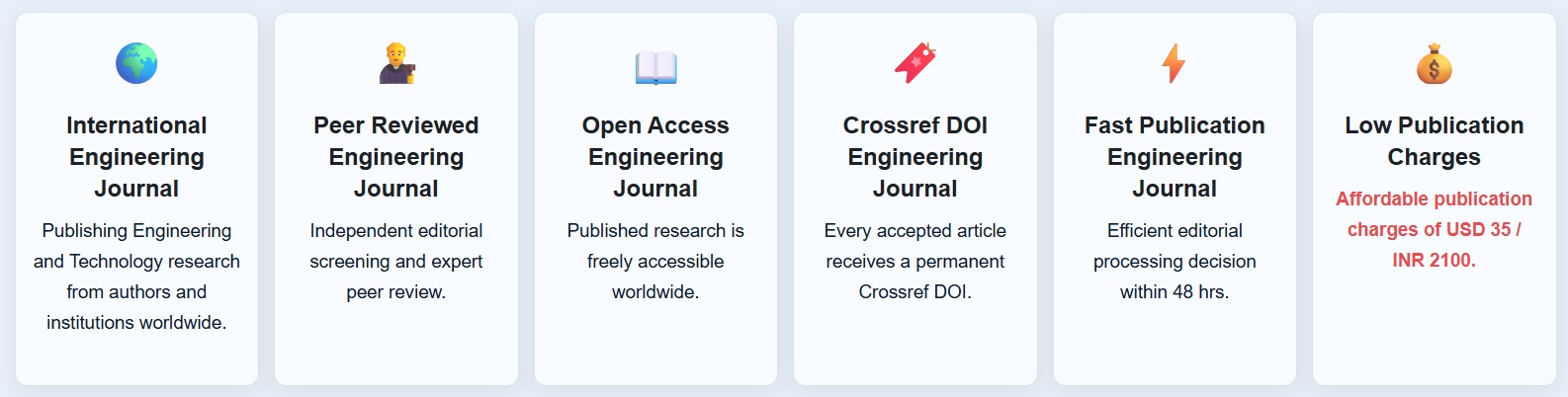
- 🌍 International Open Access Journal
- 👨⚖️ Independent Peer Review
- ⚡ Fast Editorial Processing and Publishing
- 🔗 Crossref DOI at No Additional Cost
- 📜 Free Certificate of Publication
- 💰 Low Article Processing Charges: USD 35 / INR 2100
- 📚 Broad Engineering and Technology Research Coverage
Authors should review the relevant policies, prepare complete declarations, verify manuscript accuracy, and obtain all required approvals before submission. Publication charges do not influence editorial screening, reviewer selection, peer review, correction, retraction, or acceptance decisions.
❓ Frequently Asked Questions About GJETA Journal Policies
1. What are the Journal Policies of GJETA?
The Journal Policies of the Global Journal of Engineering and Technology Advances (GJETA) explain the standards and procedures governing manuscript submission, peer review, publication ethics, research data, authorship, open access, copyright, corrections, withdrawals, retractions, privacy, and author responsibilities.
2. Why should authors read the Journal Policies before submission?
Authors should read the Journal Policies of the Global Journal of Engineering and Technology Advances (GJETA) to understand originality, authorship, ethical approval, data, AI disclosure, copyright, peer review, payment, withdrawal, correction, and publication requirements.
3. Do the Journal Policies require all authors to approve submission?
Yes. The Journal Policies of the Global Journal of Engineering and Technology Advances (GJETA) require all listed authors to know about, review, and approve the submitted manuscript and accept responsibility for their contributions.
4. Do the Journal Policies separate publication charges from editorial decisions?
Yes. The Journal Policies confirm that publication charges at the Global Journal of Engineering and Technology Advances (GJETA) remain separate from editorial screening, reviewer selection, peer review recommendations, revision requirements, and final acceptance decisions.
5. How do the Journal Policies address privacy?
The Journal Policies of the Global Journal of Engineering and Technology Advances (GJETA) explain how personal and professional information may be collected and used for manuscript processing, peer review, publication, communication, record-keeping, legal compliance, and research-integrity procedures.
6. Can authors withdraw a manuscript under the Journal Policies?
Yes. The Journal Policies allow authors to request withdrawal from the Global Journal of Engineering and Technology Advances (GJETA) through the formal withdrawal procedure. Authors should wait for written confirmation before submitting the manuscript elsewhere.
7. What happens when published errors are identified under the Journal Policies?
When errors are identified, the Global Journal of Engineering and Technology Advances (GJETA) may issue a correction, expression of concern, retraction, metadata update, or another notice according to the seriousness and effect of the concern.
8. Where can users access all Journal Policies of GJETA?
All major Journal Policies of the Global Journal of Engineering and Technology Advances (GJETA) are listed on this page with corresponding links to the complete policy documents.