📜 Publication Ethics Policy | Global Journal of Engineering and Technology Advances (GJETA)
Promoting Ethical, Transparent and Responsible Scholarly Publishing
The Global Journal of Engineering and Technology Advances (GJETA) is committed to maintaining the highest standards of publication ethics throughout the editorial and publishing process. As an international peer-reviewed open access journal, GJETA promotes honesty, transparency, fairness, accountability, and research integrity in every manuscript submitted for publication. Authors, reviewers, editors, and publishers are expected to follow internationally accepted ethical principles to ensure that published research contributes reliably to the advancement of engineering, technology, applied sciences, and interdisciplinary research.
This Publication Ethics Policy outlines the ethical responsibilities of all parties involved in scholarly publishing with GJETA. The journal supports responsible research practices, objective editorial decisions, confidential peer review, proper attribution of intellectual contributions, and transparent handling of ethical concerns. GJETA follows internationally recognized publishing standards and encourages compliance with the recommendations of organizations such as COPE (Committee on Publication Ethics), ICMJE where applicable, and Crossref best practices to maintain the integrity and credibility of the scholarly record.
🎯 Purpose of the Publication Ethics Policy
The purpose of this Publication Ethics Policy is to establish clear ethical standards for authors, reviewers, editors, editorial board members, and the publisher. Ethical publishing strengthens confidence in scientific communication, improves the quality of published research, protects intellectual property, and ensures that research findings remain trustworthy for researchers, institutions, policymakers, industry professionals, and the wider academic community.
GJETA believes that ethical publishing is a shared responsibility. Every participant in the publication process contributes to maintaining fairness, transparency, and academic integrity. Compliance with this policy helps prevent research misconduct, supports objective editorial evaluation, and preserves confidence in published engineering and technology research.
⚖️ Core Principles of Publication Ethics
The editorial policies of GJETA are guided by internationally accepted ethical publishing principles. These principles apply to every manuscript regardless of research discipline, institution, funding source, or country of origin.
- Research Integrity
Research submitted to GJETA should be conducted honestly, accurately, and responsibly without fabrication, falsification, selective reporting, or manipulation of research findings. - Originality
Submitted manuscripts must represent original scholarly work that has not been previously published or simultaneously submitted to another journal. - Transparency
Authors should accurately describe research methods, data collection procedures, analytical approaches, limitations, funding sources, and any relevant declarations that may influence interpretation of the work. - Fair Editorial Assessment
Editorial decisions are based solely on academic merit, scientific quality, originality, relevance to the journal scope, and compliance with ethical standards without discrimination based on nationality, gender, institutional affiliation, religion, ethnicity, or political views. - Confidentiality
All submitted manuscripts, reviewer reports, editorial communications, and publication records are handled confidentially throughout the editorial and peer review process. - Accountability
Editors, reviewers, authors, and the publisher share responsibility for maintaining ethical publishing practices and correcting the scholarly record whenever necessary.
👨🔬 Ethical Responsibilities of Authors
Authors submitting manuscripts to GJETA are expected to follow internationally accepted standards of responsible research and publication ethics. By submitting a manuscript, authors confirm that the work complies with the ethical requirements described in this policy.
✔ Original Research
Authors must submit only original work developed through ethical research practices. Any material reproduced from previously published sources should be properly acknowledged, cited, and used only with appropriate permission where required.
✔ Accurate Reporting
Research findings should be presented honestly and accurately without fabrication, falsification, inappropriate image manipulation, or misleading interpretation. Conclusions should be supported by the presented evidence.
✔ Proper Citation
Authors are responsible for appropriately acknowledging the work of other researchers through accurate citations and references. Proper citation demonstrates scholarly integrity and enables readers to verify the research context.
✔ Multiple or Duplicate Submission
A manuscript submitted to GJETA must not be under consideration by another journal at the same time. Duplicate publication, redundant publication, or simultaneous submission is considered unethical and may result in editorial action.
✔ Authorship Integrity
Only individuals who have made substantial scholarly contributions to the research should be listed as authors. All listed authors should approve the final manuscript before submission and agree to its publication.
✔ Disclosure of Conflicts of Interest
Authors should disclose any financial, institutional, professional, or personal relationships that could potentially influence the research, peer review, or interpretation of the published work.
✔ Compliance with Ethical Standards
Where applicable, authors should ensure that research involving humans, animals, confidential information, or regulated materials has received appropriate ethical approval and complies with relevant institutional and legal requirements.
🧑💼 Ethical Responsibilities of Editors
Editors of the Global Journal of Engineering and Technology Advances (GJETA) are responsible for ensuring that every submitted manuscript is evaluated fairly, confidentially, independently, and according to the journal’s editorial policies. Editorial decisions must be based on the academic quality, originality, relevance, methodological soundness, ethical compliance, and contribution of the manuscript to engineering, technology, applied science, and interdisciplinary research.
✔ Fair and Impartial Evaluation
Editors must evaluate manuscripts without discrimination based on the authors’ nationality, gender, institutional affiliation, ethnicity, religion, political views, professional status, or geographical location. The identity or reputation of an author or institution should not influence the editorial decision.
✔ Editorial Independence
Editorial decisions should remain independent of commercial, financial, institutional, or personal influence. Editors must not allow publication charges, advertising arrangements, sponsorship, or other business considerations to affect the acceptance or rejection of a manuscript.
✔ Confidentiality of Submitted Manuscripts
Editors must protect the confidentiality of all submitted manuscripts and related communications. Manuscript content should not be shared with anyone other than the corresponding author, assigned reviewers, relevant editorial staff, and individuals directly involved in the publication process.
✔ Selection of Qualified Reviewers
Editors should select reviewers with suitable subject knowledge, research experience, and professional competence. Reviewers should be chosen based on their ability to provide an objective, constructive, timely, and confidential assessment of the manuscript.
✔ Management of Conflicts of Interest
Editors must disclose and appropriately manage any conflict of interest that may affect their ability to handle a manuscript objectively. An editor should withdraw from the editorial process when a personal, professional, financial, institutional, or academic relationship could compromise impartiality.
✔ Protection of Reviewer Independence
Editors should protect reviewers from inappropriate influence and ensure that reviewer recommendations are considered objectively. Although reviewer comments support editorial decision-making, the final responsibility for acceptance, revision, or rejection remains with the journal editor.
✔ Timely Editorial Decisions
Editors should make reasonable efforts to complete manuscript screening, peer review coordination, and editorial decision-making without unnecessary delay. Authors should receive clear communication regarding revisions, ethical concerns, rejection reasons, or other editorial requirements.
✔ Handling Ethical Complaints
Editors must take allegations of plagiarism, data manipulation, duplicate submission, undisclosed conflicts of interest, authorship disputes, unethical research, citation manipulation, and other forms of misconduct seriously. Such concerns should be reviewed carefully, confidentially, and fairly before any editorial action is taken.
👨⚖️ Ethical Responsibilities of Reviewers
Peer reviewers play an important role in maintaining the quality and integrity of research published by GJETA. Reviewers are expected to assess manuscripts objectively, respectfully, confidentially, and within the agreed review period.
✔ Objective and Constructive Review
Reviewers should evaluate the manuscript on the basis of research quality, originality, technical accuracy, methodology, clarity, relevance, and contribution to the field. Reviewer comments should be specific, evidence-based, professional, and helpful to both authors and editors.
✔ Respectful Communication
Review reports must not contain insulting, discriminatory, hostile, or personally directed remarks. Criticism should focus on the manuscript, its methods, interpretation, structure, presentation, or scholarly contribution rather than on the authors.
✔ Reviewer Confidentiality
Reviewers must treat manuscripts as confidential documents. They must not share, reproduce, distribute, discuss, or use unpublished information from the manuscript for personal, academic, commercial, or competitive advantage.
✔ Disclosure of Reviewer Conflicts
A reviewer should decline the review when a conflict of interest may interfere with an impartial assessment. Potential conflicts may arise from professional collaboration, institutional relationships, personal disputes, financial interests, academic competition, or close involvement with the subject under review.
✔ Identification of Relevant Literature
Reviewers may identify important published research that has not been adequately discussed or cited. However, reviewers must not request unnecessary citations to their own work or recommend references solely to increase citation counts.
✔ Reporting Suspected Misconduct
If a reviewer identifies possible plagiarism, duplicate publication, fabricated data, manipulated images, unethical research practices, undisclosed conflicts, or substantial overlap with another work, the concern should be reported confidentially to the editor with supporting evidence where possible.
✔ Timely Completion of Reviews
Reviewers should accept assignments only when they can complete the evaluation within the specified period. When a reviewer is unable to complete the review on time, the editor should be informed promptly so that alternative arrangements can be made.
🏛️ Ethical Responsibilities of the Publisher
The publisher of the Global Journal of Engineering and Technology Advances (GJETA) supports the editorial team in maintaining an independent, transparent, ethical, and reliable publishing process. The publisher is responsible for protecting the integrity of the journal while ensuring that editorial decisions remain under the authority of qualified editors.
✔ Protection of Editorial Independence
The publisher must not interfere with editorial decisions for financial, commercial, personal, or institutional reasons. Manuscript decisions should be determined by academic merit, peer review, ethical compliance, and relevance to the journal’s scope.
✔ Maintenance of the Scholarly Record
The publisher should support appropriate corrections, retractions, withdrawals, expressions of concern, and article updates when necessary. Any changes to the published record should be clearly documented and linked to the original article wherever technically possible.
✔ Publication Transparency
Information concerning journal ownership, editorial policies, peer review procedures, publication charges, copyright, licensing, access conditions, and author responsibilities should be made available clearly to authors and readers.
✔ Digital Preservation and Accessibility
The publisher should take reasonable measures to support the long-term availability, discoverability, and preservation of published content. Published articles should remain accessible according to the journal’s open access, copyright, archiving, and licensing policies.
✔ Protection Against Unethical Publishing Practices
The publisher should support editors in preventing plagiarism, duplicate publication, fabricated peer review, citation manipulation, fraudulent authorship, data falsification, image manipulation, and other activities that may damage the integrity of the journal or scholarly literature.
🔍 Editorial Screening and Decision Process
Every manuscript submitted to GJETA may undergo an initial editorial screening before peer review. This screening helps determine whether the manuscript is relevant to the journal scope, sufficiently complete, professionally presented, original, and compliant with basic ethical and technical requirements.
A manuscript may be returned to the authors, requested for correction, or rejected before peer review when it:
- falls outside the journal’s engineering, technology, applied science, or interdisciplinary scope;
- does not meet minimum academic or technical standards;
- contains substantial plagiarism or unattributed material;
- has been published previously or submitted simultaneously elsewhere;
- does not provide required ethical declarations or approvals;
- contains unreliable, fabricated, falsified, or manipulated information;
- does not follow the journal’s manuscript preparation requirements;
- raises serious concerns regarding authorship, data integrity, or research conduct.
Manuscripts that successfully complete editorial screening may be assigned to independent reviewers. Reviewer recommendations are considered carefully, but they do not automatically determine the final decision. Editors may request revisions, seek additional expert evaluation, reject the manuscript, or accept it when the work meets the journal’s scholarly and ethical standards.
🔐 Confidentiality During Editorial and Peer Review
GJETA treats all unpublished manuscripts and associated editorial records as confidential. Editors, reviewers, editorial assistants, and other individuals involved in manuscript processing must not disclose manuscript information to unauthorized persons.
Unpublished research findings, technical methods, figures, data, software concepts, engineering designs, experimental results, or other intellectual content obtained through the editorial process must not be used for personal research, commercial development, competitive benefit, or professional advantage without the written permission of the authors.
Confidentiality obligations continue even after a reviewer declines the invitation, the manuscript is rejected, the review is completed, or the editorial process has concluded.
⚠️ Conflicts of Interest and Competing Interests
A conflict of interest exists when personal, financial, professional, academic, institutional, or commercial relationships could influence—or appear to influence—the conduct, evaluation, interpretation, or publication of research.
Authors, reviewers, editors, and editorial board members are expected to disclose relevant competing interests. Disclosure does not automatically prevent publication or participation in the editorial process; however, it allows the journal to evaluate and manage the situation transparently.
Examples of possible conflicts include:
- employment, consultancy, advisory, or financial relationships;
- research funding, sponsorship, grants, or equipment support;
- patent ownership, licensing interests, or commercial applications;
- recent academic collaboration or institutional affiliation;
- personal relationships or professional disputes;
- direct competition in the same research area;
- editorial responsibility for a manuscript written by a colleague, student, supervisor, or close collaborator.
Where an editor has a conflict of interest, responsibility for the manuscript should be transferred to another qualified editor whenever possible.
🛡️ Research Integrity and Ethical Oversight
GJETA expects all submitted research to comply with applicable institutional, national, professional, and legal standards. Authors are responsible for obtaining required ethical approval, informed consent, regulatory authorization, institutional permission, or other documentation before conducting and submitting relevant research.
The journal may request supporting documentation when a manuscript involves:
- human participants or identifiable personal information;
- animal experimentation;
- confidential institutional, industrial, or government data;
- hazardous materials or regulated technologies;
- field studies requiring environmental, community, or institutional permission;
- research involving security-sensitive systems or restricted technical information;
- surveys, interviews, case studies, or observational research involving individuals.
When ethical approval is not required under applicable rules, authors may be asked to provide a clear explanation. Misrepresentation of ethical approval, participant consent, institutional permission, or regulatory compliance may result in manuscript rejection or post-publication action.
🚫 Research Misconduct and Unethical Publication Practices
The Global Journal of Engineering and Technology Advances (GJETA) does not tolerate research misconduct or unethical publication practices. Any action that intentionally misrepresents research, authorship, data, peer review, citations, or the publication process may be investigated by the journal.
Research misconduct may occur before submission, during peer review, after acceptance, or following publication. Ethical concerns may be raised by editors, reviewers, readers, institutions, authors, research participants, or other parties with relevant evidence.
Examples of misconduct include:
- fabrication or invention of research data, observations, experiments, or results;
- falsification, alteration, suppression, or selective presentation of data;
- plagiarism, unattributed copying, or inappropriate reuse of published material;
- duplicate submission, redundant publication, or simultaneous submission;
- guest authorship, honorary authorship, ghost authorship, or exclusion of legitimate contributors;
- manipulation of citations or inappropriate pressure to cite specific publications;
- fabricated, compromised, or manipulated peer review;
- undisclosed conflicts of interest;
- misrepresentation of ethical approval, consent, funding, affiliation, or institutional permission;
- inappropriate manipulation of images, figures, tables, graphs, or technical outputs;
- use of confidential manuscript information for personal or commercial advantage;
- submission of misleading, deceptive, or fraudulent declarations.
When credible concerns arise, GJETA may request explanations, original data, ethical approval documents, authorship statements, image files, technical records, correspondence, or other supporting material. Failure to cooperate with a reasonable ethical inquiry may influence editorial or post-publication action.
📄 Plagiarism and Unattributed Content
All manuscripts submitted to GJETA must be original and properly referenced. Authors are responsible for ensuring that words, ideas, methods, data, figures, tables, software outputs, technical designs, and other intellectual contributions from existing sources are accurately acknowledged.
Plagiarism may include:
- copying text without citation or quotation where appropriate;
- closely paraphrasing another source without acknowledgment;
- presenting another researcher’s idea, data, method, figure, or conclusion as original;
- reusing previously published content without transparent citation;
- translating published material from another language without attribution;
- using copyrighted content without required authorization;
- submitting content created by another person while claiming authorship.
Similarity alone does not always establish plagiarism. References, standard technical terminology, commonly used methods, institutional names, and unavoidable subject-specific expressions may contribute to similarity. Editors assess the nature, extent, location, and context of overlapping material before taking action.
Depending on the seriousness of the concern, the journal may request revision, reject the manuscript, suspend editorial processing, contact the authors’ institution, or take appropriate post-publication action.
🔁 Duplicate Submission and Redundant Publication
Authors must not submit the same manuscript to GJETA and another journal simultaneously. A manuscript should remain under consideration by only one journal at a time.
Redundant publication occurs when substantially similar research is published more than once without clear disclosure, justification, citation, or editorial permission. This may include repeated publication of the same data, analysis, figures, conclusions, or study population with only minor changes.
Secondary publication may be considered only in limited circumstances when it is ethically justified, transparently disclosed, appropriately cited, and approved by the relevant editors and rights holders.
📊 Data Accuracy, Availability and Research Records
Authors should maintain accurate research records and preserve the underlying data for a reasonable period in accordance with institutional, disciplinary, legal, contractual, and funding requirements.
The journal may request original or supporting data when necessary to:
- verify reported results;
- investigate concerns regarding fabrication or falsification;
- assess statistical or technical inconsistencies;
- clarify discrepancies between text, tables, figures, or supplementary files;
- evaluate corrections, retractions, or other post-publication updates.
Research data should not be selectively removed, altered, concealed, or presented in a misleading manner. Authors should describe exclusions, missing data, transformations, preprocessing, and analytical decisions clearly enough to support reliable interpretation.
Where data cannot be shared because of privacy, confidentiality, legal, contractual, security, commercial, or ethical restrictions, authors should explain the limitation transparently.
🖼️ Image, Figure and Graph Integrity
Images, figures, graphs, diagrams, technical illustrations, and visual research outputs must accurately represent the underlying results. Adjustments intended to improve clarity are acceptable only when they do not alter, obscure, remove, exaggerate, or misrepresent relevant information.
Unacceptable practices may include:
- adding, deleting, moving, or duplicating visual elements;
- combining images without clear separation or explanation;
- adjusting brightness, contrast, scale, or color in a misleading way;
- reusing the same image to represent different experiments or conditions;
- cropping images to conceal relevant findings;
- presenting simulated, generated, or modified images as authentic research evidence;
- altering graphs or axes to exaggerate or minimize observed effects.
GJETA may request original image files, raw outputs, metadata, or related records when concerns arise. Any acceptable enhancement or composite presentation should be described transparently in the figure legend or methods section.
👥 Authorship and Contributor Disputes
Authorship should reflect genuine intellectual and scholarly contribution. All listed authors must approve the submitted manuscript and accept responsibility for their contributions.
Disputes may involve:
- omission of a legitimate contributor;
- addition of an individual who did not make a qualifying contribution;
- disagreement regarding author order;
- unauthorized submission by one contributor;
- changes to authorship after submission or acceptance;
- misrepresentation of contributor roles.
The journal does not determine legal ownership of research or resolve institutional employment disputes. When authors cannot reach agreement, GJETA may suspend editorial processing and request clarification or a formal determination from the relevant institution.
Requests to add, remove, or reorder authors should be supported by a clear explanation and written agreement from all affected authors. Changes after acceptance or publication may require additional review and formal correction.
💰 Funding, Sponsorship and Competing Interests
Authors should identify funding sources, sponsorship, institutional support, equipment support, commercial involvement, or other assistance relevant to the research. They should also disclose whether the funder influenced the study design, data collection, analysis, interpretation, manuscript preparation, or decision to publish.
Transparent disclosure allows editors and readers to assess whether external relationships could reasonably affect the research or its interpretation. The existence of funding or a competing interest does not automatically prevent publication, but failure to disclose a relevant relationship may result in editorial action.
📚 Citation Ethics and Citation Manipulation
References should be selected because they are relevant, reliable, and necessary to explain the research context. Authors must not include citations solely to increase the citation count of a particular author, journal, institution, or research group.
Editors and reviewers must not pressure authors to add irrelevant citations. Suggestions for additional references should be based on genuine scholarly value, methodological relevance, or the need to acknowledge important prior work.
Coordinated citation exchanges, excessive self-citation, citation cartels, and other forms of citation manipulation are inconsistent with the Publication Ethics Policy of GJETA.
🧑⚖️ Handling Allegations of Misconduct
Ethical concerns submitted to GJETA should be specific, evidence-based, and made in good faith. Anonymous concerns may be considered when sufficient information is provided to support a fair review.
The journal may follow these steps when evaluating an allegation:
- conduct an initial assessment of the concern and available evidence;
- determine whether the allegation falls within the journal’s editorial responsibility;
- contact the author, reviewer, editor, or other relevant party for clarification;
- request original data, declarations, approvals, correspondence, or supporting records;
- consult additional experts or editorial board members where appropriate;
- contact an institution, research office, funder, ethics committee, or publisher when necessary;
- decide whether correction, rejection, retraction, withdrawal, expression of concern, or no further action is appropriate.
The journal will seek to handle allegations confidentially, impartially, and without unnecessary delay. An allegation does not by itself establish misconduct. Decisions should be based on available evidence and the seriousness of the concern.
📢 Complaints and Appeals
Authors, reviewers, readers, and other stakeholders may submit a complaint regarding editorial conduct, peer review, ethical handling, published content, or journal procedures. Complaints should clearly describe the issue and include relevant supporting information.
Authors may also appeal an editorial decision when they believe that a significant factual misunderstanding, procedural error, or overlooked evidence affected the outcome. An appeal should explain the grounds clearly and should not merely repeat arguments already considered during peer review.
Where appropriate, a complaint or appeal may be reviewed by an editor who was not directly responsible for the original decision. Submission of an appeal does not guarantee reconsideration, external review, or acceptance.
✏️ Corrections and Article Updates
When an error is identified in a published article, GJETA will consider whether the issue affects interpretation, accuracy, attribution, discoverability, or the scholarly record.
Minor errors that do not affect meaning may be corrected when appropriate. More substantial errors may require a formal correction notice linked to the published article.
Corrections should:
- identify the affected article clearly;
- describe the error and the corrected information;
- avoid obscuring the original publication history;
- remain accessible as part of the permanent scholarly record.
⛔ Retractions and Expressions of Concern
Retraction may be considered when published findings are unreliable because of fabrication, falsification, serious error, unethical research, plagiarism, duplicate publication, compromised peer review, or another major breach of publication ethics.
A retraction notice should explain the reason for the action and remain linked to the original article. Retracted content should generally remain accessible and clearly marked so that the publication history is preserved.
An expression of concern may be issued when serious questions exist but the available evidence is incomplete, disputed, or under investigation. The notice may later be replaced or supplemented by a correction, retraction, or other editorial update.
📤 Manuscript Withdrawal
Authors may request withdrawal of a manuscript by providing a clear reason and obtaining agreement from all listed authors. Withdrawal requests should be submitted promptly and before publication.
Withdrawal does not erase concerns related to duplicate submission, plagiarism, fabricated information, authorship disputes, or other ethical issues identified during editorial processing. The journal may retain relevant records and continue an ethical inquiry where necessary.
🛠️ Enforcement of the Publication Ethics Policy
The action taken by GJETA will depend on the seriousness, evidence, timing, and potential impact of the ethical concern. Possible actions include:
- requesting clarification or supporting documents;
- requiring manuscript revision;
- rejecting or withdrawing a manuscript;
- suspending editorial processing;
- removing a reviewer or editor from a particular manuscript;
- issuing a correction, retraction, or expression of concern;
- restricting future submissions for a defined period;
- contacting an institution, funder, ethics committee, or relevant authority;
- correcting journal records and metadata.
Editorial actions are intended to protect the integrity of the scholarly record rather than to impose punishment without evidence. Each matter will be considered according to its circumstances.
🔒 Protection of Whistleblowers and Good-Faith Reporting
Individuals who report ethical concerns in good faith should provide accurate information and avoid malicious, misleading, or retaliatory allegations. GJETA will make reasonable efforts to protect the confidentiality of individuals raising concerns, subject to legal, procedural, or investigative requirements.
Knowingly false allegations, harassment, intimidation, or misuse of the complaints process may themselves be treated as unethical conduct.
🌐 Maintaining the Integrity of the Scholarly Record
The primary purpose of this Publication Ethics Policy is to ensure that research published by the Global Journal of Engineering and Technology Advances (GJETA) remains accurate, transparent, reliable, and useful to the international research community.
Authors, reviewers, editors, institutions, and the publisher share responsibility for identifying errors, correcting the literature, disclosing relevant information, and cooperating with ethical inquiries. Responsible post-publication action strengthens rather than weakens scholarly communication because it demonstrates accountability and protects readers from unreliable information.
🌟 Why the Publication Ethics Policy Matters
A clear and consistently applied Publication Ethics Policy helps protect authors, reviewers, editors, readers, institutions, and the wider research community. It ensures that manuscripts are evaluated fairly, published research is presented responsibly, and ethical concerns are addressed through transparent procedures.
For the Global Journal of Engineering and Technology Advances (GJETA), publication ethics are essential for maintaining confidence in engineering, technology, applied science, and interdisciplinary research. Reliable scholarly communication enables researchers, professionals, educators, policymakers, and industry specialists to make informed decisions based on accurate and trustworthy evidence.
This policy also helps GJETA:
- maintain the credibility and reliability of published research;
- promote honest reporting and responsible authorship;
- protect the confidentiality and independence of peer review;
- prevent plagiarism, fabrication, falsification, and duplicate publication;
- manage conflicts of interest transparently;
- support fair editorial decisions;
- correct or update the scholarly record when necessary;
- strengthen trust between authors, reviewers, editors, and readers.
🔗 Related GJETA Editorial and Publishing Policies
Authors, reviewers, editors, and readers are encouraged to review the related policies of the Global Journal of Engineering and Technology Advances to understand the journal’s complete ethical and editorial framework.
⚠️ Conflict of Interest Policy
📤 Manuscript Withdrawal Policy
©️ Copyright and Licensing Policy
🚀 Publish Responsible Research with GJETA
The Global Journal of Engineering and Technology Advances (GJETA) provides an international platform for the publication of original research, review articles, case studies, technical papers, short communications, and interdisciplinary studies in engineering, technology, applied sciences, and emerging research fields.
- 🌍 International Open Access Journal
- 👨⚖️ Independent Peer Review
- ⚡ Fast Editorial Processing and Publishing
- 🔗 Crossref DOI at No Additional Cost
- 📜 Free Certificate of Publication
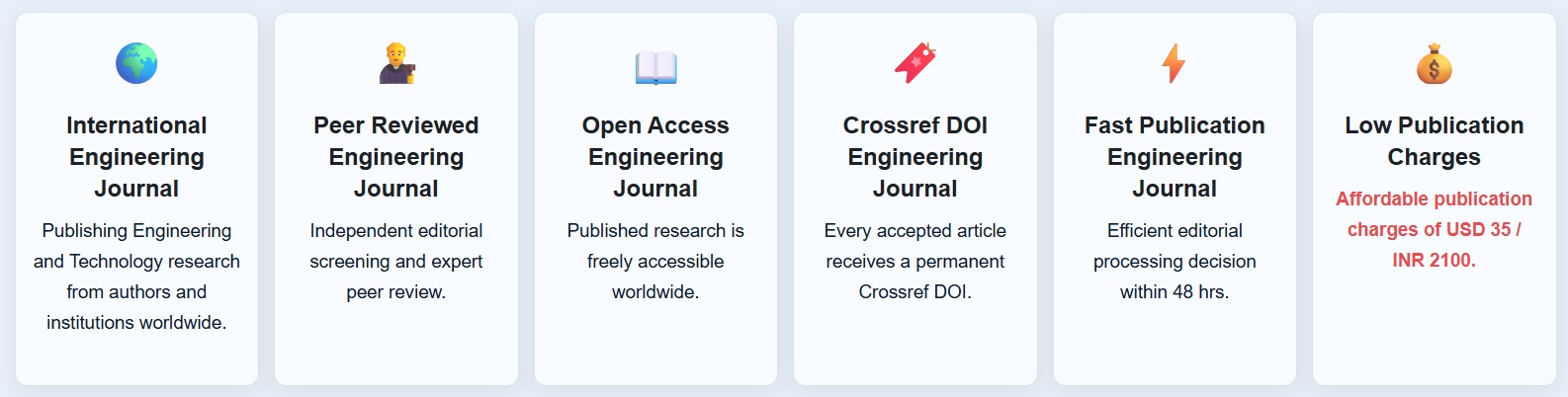
- 💰 Low Article Processing Charges: USD 35 / INR 2100
- 📚 Broad Engineering and Technology Research Coverage
Publication charges do not influence editorial screening, peer review, or acceptance decisions. Every manuscript must satisfy the journal’s academic, technical, ethical, and editorial requirements before publication.
📩 Reporting an Ethical Concern
Authors, reviewers, readers, and institutions may report suspected ethical concerns related to a submitted or published manuscript. Reports should identify the affected manuscript or article, explain the concern clearly, and include supporting evidence where available.
The Global Journal of Engineering and Technology Advances will review credible concerns confidentially and impartially. The journal may contact relevant authors, reviewers, editors, institutions, funders, ethics committees, or other responsible organizations when additional information is required.
Ethical concerns should be submitted through the journal’s official contact channel. Deliberately false, malicious, or unsupported allegations may not be considered.
❓ Frequently Asked Questions About the Publication Ethics Policy
1. What is the Publication Ethics Policy of GJETA?
The Publication Ethics Policy of the Global Journal of Engineering and Technology Advances (GJETA) explains the ethical responsibilities of authors, reviewers, editors, and the publisher. It establishes standards for originality, research integrity, fair peer review, confidentiality, authorship, conflicts of interest, and correction of the scholarly record.
2. Why is the Publication Ethics Policy important for authors?
The Publication Ethics Policy helps authors understand the standards expected by the Global Journal of Engineering and Technology Advances (GJETA). It supports original research, accurate reporting, proper citation, transparent declarations, responsible authorship, and compliance with relevant ethical requirements.
3. What misconduct is covered by the Publication Ethics Policy?
The Publication Ethics Policy of the Global Journal of Engineering and Technology Advances (GJETA) covers plagiarism, fabrication, falsification, duplicate submission, redundant publication, manipulated peer review, citation manipulation, improper authorship, undisclosed conflicts of interest, and misleading ethical declarations.
4. How does the Publication Ethics Policy address plagiarism?
Under the Publication Ethics Policy, the Global Journal of Engineering and Technology Advances (GJETA) requires authors to submit original work and properly acknowledge all sources. Suspected plagiarism may result in revision requests, rejection, suspension of processing, or post-publication action depending on its seriousness.
5. Does the Publication Ethics Policy apply to reviewers and editors?
Yes. The Publication Ethics Policy of the Global Journal of Engineering and Technology Advances (GJETA) requires reviewers and editors to maintain confidentiality, disclose conflicts of interest, evaluate manuscripts objectively, avoid citation manipulation, and report credible ethical concerns.
6. How are complaints handled under the Publication Ethics Policy?
The Global Journal of Engineering and Technology Advances (GJETA) reviews complaints submitted under the Publication Ethics Policy fairly, confidentially, and on the basis of available evidence. The journal may request clarification, supporting documents, original data, or institutional assistance before making a decision.
7. Can an article be corrected or retracted under the Publication Ethics Policy?
Yes. The Publication Ethics Policy allows the Global Journal of Engineering and Technology Advances (GJETA) to issue corrections, retractions, expressions of concern, or other updates when necessary to protect the accuracy and reliability of the scholarly record.
8. How can someone report a concern under the Publication Ethics Policy?
A concern under the Publication Ethics Policy may be reported to the Global Journal of Engineering and Technology Advances (GJETA) through its official contact channel. The report should identify the relevant manuscript or article and provide a clear explanation with supporting evidence where possible.